
Pragmatic competence in multi-party talk: Teaching EAP students turn-initial language.
Helen Butt
Language Centre, School of Languages, Cultures and Societies, University of Leeds
ABSTRACT
One gap in EAP research is the language needed for turn-taking in multi-party academic talk. This language is important for pragmatic competence in speech, since it is used to manage the relationships within the discourse (Aijmer, 2011; Evison, 2013; Viana and O’ Boyle, 2021). While studies by Evison (2013) and Bardovi-Harlig et al. (2015) investigate useful turn-taking language in academic speech generally, they do not investigate the use of such language specifically in multi-party settings. The purpose of the current study is therefore to determine which vocabulary used at turn openings in more interactive academic talk needs to be taught so that EAP students can both understand the stance of the other interlocutors and take the floor in multi-party talk on their academic courses. To this end, the data sets proposed by both Evison (2013) and Bardovi-Harlig et al. (2015) are re-evaluated using only the seminars and study groups in the Michigan Corpus of Spoken Academic English. The results of this evaluation show that the most prevalent turn-initial lexes are multi-faceted and semantically nuanced words such as yeah and well. These words, however, tend to be used either inappropriately or not at all by language learners (Aijmer, 2011; Polat, 2011; and Lo, 2013). Thus, EAP teachers need to be cognisant of both the appropriate words to teach and strategies for teaching them (see Bardovi-Harlig et al., 2015; Heron, 2019; Tomlinson, 2020; Williams, 1988; Wong and Waring, 2010). This paper therefore concludes with a brief overview of pedagogic strategies suggested in the literature, such as providing class time for students to notice the target language in context along with scaffolded practice (Ryan and Forrest, 2021).
KEYWORDS: English for Academic Purposes, pragmatic competence, discourse management, turn-initial tokens, multi-party talk
INTRODUCTION
English for Academic Purposes (EAP) might have developed since its origins in the 1970s (Bell, 2024; Ding and Bruce, 2017) but EAP literacy still tends to focus on reading and writing rather than speaking and listening (Ding and Bruce, 2017). Where the latter are the focus of instruction, the purpose is more likely to be improving the students’ understanding and expression of content, rather than developing pragmatic competence, the ability to use language in a contextually appropriate way, in the target language (Cohen, 2017; Wright et al., 2022). Furthermore, whilst research into pragmatics in higher education has been conducted (cf. Youn, 2018) and there appear to have been ‘a plethora of studies’ ( Farahani and Ghane, 2022, p. 50) on the subject of discourse management in writing, this is not the case with the language needed for turn-taking, such as for showing agreement or exemplifying (Farahani and Ghane, 2022).
This lack of pragmatic knowledge is likely to have a detrimental effect on EAP students and their learning, since it is crucial for engagement in multi-party talk (Bardovi-Harlig et al., 2015; Farahani and Ghane, 2022). Multi-party talk such as seminars forms part of most courses in higher education (Basturkmen, 1999; Bardovi-Harlig et al., 2015; Dang, 2018; Heron, 2019; Heron et al., 2021; Lin, 2015; Walsh et al., 2011) and requires competence in turn-taking, since it is the start of an utterance in English which contains the stance of the current speaker (Evison, 2013; Farahani and Ghane, 2022; Heron, 2019; Polat, 2011; Viana and O’ Boyle, 2021; Wright et al., 2022), an understand of which enables appropriate next-turn preparation (Farahani and Ghane, 2022; Young, 2018). However, it has been shown that language learners ‘develop pragmatic competence very slowly’ without instruction (Caprario, 2020, p. 127; see also Ryan and Forrest, 2015, 2021) and if EAP teachers are to provide adequate instruction, they need to have the knowledge to support their students but this is not currently the case (see Bardovi-Harlig et al., 2015; Heron, 2019; Tomlinson, 2020; Williams, 1988; Wong and Waring, 2010).
In view of the importance of pragmatic competence for learning during academic multi-party talk such as seminars, the aim of this study is to determine which words or phrases are most likely to be used to take the floor in these circumstances, so that EAP students can both understand and actively participate in all forms of group work. Such information appears to be available in the literature but either the researchers have chosen a discreet set of tokens to analyse (e.g. Farahani and Ghane, 2022), have looked for expressions which perform a pre-determined set of functions (e.g. Bardovi-Harlig et al., 2015) or have searched both the interactive and monologic speech events in the corpus (e.g. Evison, 2013). The totality of the data acquired would therefore benefit from being collated and verified as useful for pragmatic competence in academic speech events with multiple parties. To this end, the current study takes the data from the three most comprehensive studies identified in the literature (Bardovi-Harlig et al., 2015; Evison, 2013; Haselow, 2019) and searches for all suggested turn-initial tokens in the seminars and study groups in the Michigan Corpus of Academic Spoken English (MiCASE)[1] to determine which are most prevalent. This shows that the most useful vocabulary for taking the floor in academic multi-party talk is words such as yeah to show agreement and well to show disagreement. However, as such vocabulary has ‘subtleties in usage and shades in meanings’ (Lo, 2013, p. 21), it may be challenging for language learners to acquire, so the literature is also drawn upon for pedagogic interventions, such as EAP students being given scaffolded observations of naturally occurring interactions, so that they can acquire a fuller understanding of their linguistic choices.
DATA ON TURN-INITIAL LEXIS IN THE LITERATURE
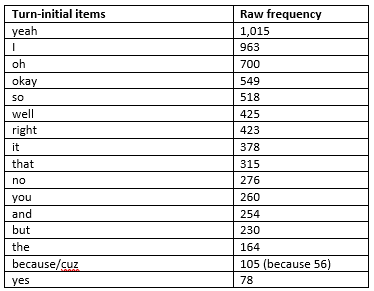
For the purposes of the current study three research projects have been used. The first study is by Evison (2013), the purpose of which is to improve the knowledge base of the Common European Framework of Reference with regard to turn-taking. The study uses CANCAD, the academic sub-corpus of the Cambridge and Nottingham Corpus of Discourse in English (CANCODE)[2], to analyse the turn-openings in a variety of academic settings (see Table 1), including lectures and PhD supervisions as well as speech events which are either more interactive or have more participants such as seminars and group tutorials. Evison (2013) then compares the data from CANCAD with that found in CANCSOC, the social language sub-corpus of CANCODE and finds that the words most likely to be uttered first upon taking the floor in social situations are broadly the same as those uttered at the start of a turn in academic contexts (Evison, 2013): the results show that the twenty forms most likely to be turn-initial are used in this position in 64.11% of utterances in CANCAD and 59.43% in CANCSOC.
Table 1: Sixteen most frequent turn-initial words in CANCAD[3] (Evison, 2013).

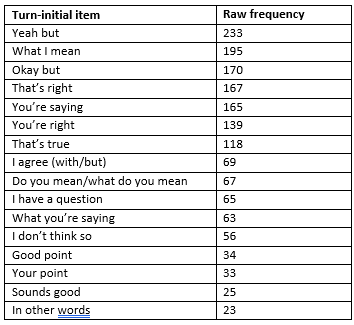
The second study is by Bardovi-Harlig et al. (2015) and its purpose is to develop teaching materials for the instruction of pragmatics in academic discussions, with a focus on expressions to show agreement, disagreement and to ask for or provide clarification. To obtain the data for this study, they search the whole of MiCASE, from lectures through to seminars, and ascertain that most frequent turn-initial expressions are as shown in Table 2.
Table 2: Sixteen most frequent expressions to indicate agreement, disagreement or clarification in MiCASE[4] (Bardovi-Harlig et al., 2015).
The third study, by Haselow (2019), is different from those by Evison (2013) and Bardovi-Harlig et al. (2015) insofar as it looks at the order of items in clusters of words (e.g. yeah well because) at the start of turns in social interactions. It uses the unscripted sections of British social English from the International Corpus of English sections S1A-S2B[5] (ICE-GB) but is useful for the current study in view of Evison’s (2013) finding that turn-taking language in academic settings is comparable to that in social settings. Indeed, a comparison of Haselow’s (2019) data in Table 3 with Evison’s (2013) findings in Table 1 supports the observation that turn-initial language is similar in both settings.
Table 3: Sixteen most frequent turn-initial tokens in ICE-GB (sections S1A-S2B) (Haselow, 2019).

There are, however, several challenges in using the data from these three studies to help EAP students develop their pragmatic competence in the act of turn-taking. As already mentioned, one is that both Evison (2013) and Bardovi-Harlig et al. (2015) use the entirety of their chosen corpus to gather data, which means that the results may be inaccurate for multi-party interactions in academia. Secondly, Evison (2013) counts only the first token rather than an entire phrase (e.g. only I instead of I mean), which means that some similarities between the corpora may be missed. Thirdly, Bardovi-Harlig et al. (2015) look at only the functions of agreement, disagreement and clarification, whereas interlocutors may also need other functions in academic multi-party talk, such as changing the focus of the discussion. Fourthly, whilst the data from Haselow (2019) bears some resemblance to that in Evison’s (2013) study, it needs to be verified in an academic corpus before it can be used in EAP teaching materials, otherwise materials writers will fall into the trap of using ‘educated guesswork and hunches’ (Williams, 1988, p. 53) rather than writing materials ‘which reflect the world as it actually is’ (Tomlinson, 2020, p. 13). In other words, EAP instruction could be improved by teachers in this field having access to data for which there is evidence of usefulness.
METHODOLOGY
In view of the considerations mentioned above, the current study uses the seven seminars and eight study groups in MiCASE, which is an open access corpus, freely available on the internet. The seminars are in the disciplines of Philosophy, French Cinema, English Composition, Public Policy, Politics of Higher Education and Buddhist Studies and the eight study groups are in Maths, Objectivism, Chemical Engineering, American Family, Biochemistry, Introduction to Biology and a group dedicated to discussing the students’ theses.
Each of these items documented by Evison (2013), Bardovi-Harlig et al. (2015) and Haselow (2019) is entered into the search engine of MiCASE to determine how frequently they are uttered in the seminars and study groups, which appear to be the most interactive multi-party speech events it contains. Then each event is manually searched to count the number of tokens which are turn-initial. If the turn-initial language is a single word, it is discounted if not said in full in order to reduce the chance of misinterpretation, for example if an interlocuter says y-, which could not only be yes or yeah but any other word starting with the phoneme /y/. Likewise, if an expression (e.g. I mean) is incomplete, it is discounted.
RESULTS
As shown above, Evison (2013) investigates the initial tokens in an utterance in academic speech generally. When this data is re-examined in only the MiCASE seminars and study groups[6], the sixteen most frequent items used as initial tokens are shown to be the same (see Table 4). The difference is in the order of frequency. For example, the first-person singular pronoun I is the third most frequent turn opening in Evison (2013) but second in the current study.
Table 4: Evison’s (2013) sixteen most frequent turn-initial items in MiCASE seminars and study groups
On the other hand, a re-evaluation of the Bardovi-Harlig’s (2015) data results in quite different findings from the original study, as shown in Table 5. In other words, the results of the re-evaluation show that such lexical items are rarely found in turn-initial position in academic multi-party talk and therefore appear to be less beneficial for EAP students to be taught than the items observed in Evison’s (2013) study.
Table 5: Bardovi-Harlig et al.’s (2015) sixteen most frequent turn-initial items in MiCASE seminars and study groups

In contrast to Bardovi-Harlig et al.’s (2015) data but similar to Evison’s (2013), the current study shows that Haselow’s (2019) data, as detailed in Table 6, are largely useful to teach on EAP courses. The exceptions may be words such as actually and anyway, which appear infrequently as turn-openers in the MiCASE seminar and study groups.
Table 6: Haselow’s (2019) sixteen most frequent turn-initial items in MiCASE seminars and study groups

DISCUSSION
In contrast to the findings of Evison (2013) and Haselow (2022), Bardovi-Harlig et al. (2015) propose a range of expressions. These are either formulaic, such as in other words, or more semantically transparent, such as what I mean, as shown in Table 2. Prioritising the acquisition of such items is, however, questionable. As the data in Tables 4, 5 and 6 demonstrate, when the language suggested by Evison (2013), Bardovi-Harlig et al. (2015) and Haselow (2019) respectively is compared in MiCASE seminars and study groups, it becomes clear that, aside from I think and I mean, expressions are uncommon turn openings.
There is also a marked contrast between the frequency of items at the top of Table 6 and those at the bottom. A similar phenomenon can be seen in Table 4, although to a lesser extent. In other words, whilst there is no doubt that yeah is important for pragmatic competence in academic multi-party talk, tokens such as actually and anyway (Table 6) may be no more useful than expressions such as I don’t think so or sounds good (Table 5). Even taking into account the variation between corpora (cf. Biber et al., 1999), dedicating time in the classroom to vocabulary for which is there is little evidential basis supports the concerns of authors such as Williams (1988) and Tomlinson (2020), as highlighted earlier in this paper. Erroneous vocabulary will not help the participants in academic multi-party talk. They are emotionally involved rather than simply exchanging information (Evison, 2013; Viana and O’ Boyle, 2021) and the turn opening ‘is characterised as a site of engagement with non-transactional needs’ (Evison, 2013, p. 5). Helping EAP students to understand the impact of the more frequently uttered words and phrases must therefore be the most appropriate strategy for improving pragmatic competence.
The impact of such expressions is the illocutionary force, the underlying socially constructed meaning. The potential impact of misusing or misunderstanding these expressions is ‘interpersonal misunderstandings’ (Al Hamdany and Picard 2015, p. 50; see also Chapman 1982; and Cohen, 2017) and a breakdown in communication (Bardovi-Harlig et al., 2015; Cohen, 2017). In other words, if listeners fail to assess the underlying socially constructed meaning of the current speaker or the current speaker fails to choose an expression with the desired illocutionary force, the consequence could be an inappropriate next turn and the need for repair work, which at best would reduce the amount of time available for learning.
Thus, the current study proposes that EAP students be given the opportunity on their courses to develop their understanding and ability to use the lexical items documented in the study by Evison (2013) for taking the floor in academic multi-party talk. That is to say, the participants in academic multi-party talk are more likely to need a pronoun, a conjunction, the discourse markers oh and well or the adverbs yeah and no than formulaic expressions such as in other words. These small words are important for pragmatic competence, without which rapport, followed by learning outcomes, may be affected.
The issue of rapport is fundamental to success in multi-talk. Subtle differences in illocutionary force can affect the social appropriateness and acceptability of an utterance (Polat, 2011; Romero Trillo, 2002). Thus, pragmatic errors can then lead to awkwardness and other negative emotions, which may inhibit learning (Al Hamdany and Picard, 2015; Caprario, 2020; see also Spencer-Oatey and Dauber, 2016). A study by Kasper in 1984 had already highlighted this phenomenon and concluded that students needed to be supported in their mastery of the pragmatic as much as the semantic meaning of utterances. Thus, it is imperative that pragmatics forms part of the teaching of vocabulary and communication skills on EAP courses.
Teachers and language learners have three overarching needs. The first is to understand the relevance of turn-initial language in academic multi-party talk. The second is an awareness of not just the kind of language that is most likely to occupy first position in an utterance in such speech events but also the nature of this language. The third is to have the mechanisms for teaching and learning such language.
Firstly, teachers and learners would benefit from understanding the salience of the turn opening with regard to response preparation in English. That is, the opening expression tells the listener broadly what the rest of the turn is about (Young, 2018), whether it is adding contradictory information or showing affiliation, for example. From this point, it is then possible and necessary to start preparing the response, otherwise it may not be ready in time for the potential respondent to take the floor at the next opportunity (Levinson, 2016; see also Ryan and Forrest, 2015 and 2021; and Tanaka, 2008). Thus, the more familiar interlocutors are with the vocabulary at turn-openings, the more easily they can either process a response on time or facilitate a timely response from others involved in the discussion.
Secondly, Ryan and Forrest (2021) describe turn-taking as dominated by ‘contingent possibilities rather than firm rules’ (p. 103). This can be illustrated with the examples of well and pronouns such as you. According to Aijmer (2011) and Polat (2011), well has several functions. In turn-initial position, it can mean that (1) the speaker is deliberating what to say; (2) the speaker is reluctant to answer a question; (3) the speaker either only half-heartedly agrees or in fact disagrees with the prior speaker; (4) the speaker is asking, in a face-saving manner, the prior speaker to reconsider what was said. With regard to pronouns, their meaning is determined by who is talking to whom (O’Boyle, 2014), for example. This means that, while the vocabulary items Evison (2013) and Haselow (2019) highlight are very common in spoken English (cf. the Longman Dictionary of Contemporary English, 2003), EAP students may still be unfamiliar with their multifarious uses and nuances in meaning.
This difficulty is demonstrated in a range of studies. Turn-initial vocabulary which has been shown to be difficult to acquire includes well (Aijmer, 2011; Polat, 2011; and Romero Trillo, 2002), I think (Baumgarten and House, 2010), yeah (House, 2013; and Lo, 2013) and agree (Kashida and Chan, 2015). Further, studies by Polat (2011) and then Kizil (2017) suggest that even motivated learners who have a high level of exposure to spoken English do not readily acquire this functional language (see also Cohen, 2017). When students are therefore unwilling or unable to find opportunities to interact in English, this could have an even greater negative bearing on the development of the students’ turn-taking ability (cf. Kesckes et al., 2018 for discussion on differences between students). Polat’s (2011) and Kizil’s (2017) conclusion is therefore that there is value in conspicuously teaching these items of vocabulary.
‘Conspicuous teaching’ could mean teachers providing noticing tasks, which both Bardovi-Harlig et al. (2015) and Ryan and Forrest (2015, 2021) demonstrate to be effective in improving pragmatic competence. In addition to this, when the students are in discussion it may be to their advantage to focus less on the language needed to express content so that they have more mental space for pragmatic considerations (Kesckes, 2007, cited in O’ Boyle, 2014). Another strategy suggested in the literature is writing a reflection after a speaking activity. This has a potential two-fold benefit in that students can learn both through observation (Caprario, 2020) and through teachers’ responses to these reflections (Ryan and Forrest, 2021).
CONCLUSION
This study has investigated the most useful vocabulary for EAP students to learn for their pragmatic competence in academic multi-party talk. To this end, it has analysed the turn-initial lexical items proposed by Bardovi-Harlig et al. (2015), Evison (2013) and Haselow (2019) and determined that the most useful tokens to master in this context are pronouns, conjunctions, the discourse markers oh and well and the adverbs yeah and no.
Whilst these words may seem familiar, they have many functions and meanings, which makes them difficult to acquire sufficiently well to facilitate turn-taking. It is therefore necessary for EAP teachers to be aware of their importance and to provide opportunities for their successful acquisition. It is also important for teachers to remember that turn-taking involves listening as well as speaking and that therefore pragmatic comprehension is as necessary as being able to choose the correct word at the correct time. If then their students become more adept at understanding the relational aspects of talk and how to display this in turn-taking, this will empower the students to increase their learning through multi-party talk on their academic courses.
Choice of vocabulary is one aspect of pragmatic competence. Others, such as prosody, have not been covered in this paper but are also likely to have a bearing on communicative outcomes. It would therefore be of benefit for teachers to be cognisant of these additional aspects and for them to dedicate time within lessons to such tuition. After all, their students deserve the opportunity to reach their potential and to do so without pragmatic failures.
Address for correspondence: [email protected]
REFERENCES
Aijmer, K. 2011. Well I’m not sure I think… The use of well by non-native speakers. International Journal of Corpus Linguistics. [Online]. 16(2), pp. 231-254. [Accessed 24 July 2024]. DOI: https://doi.org/10.1075/ijcl.16.2.04aij
Al Hamdany, H. and Picard, M. 2015. Narratives of Iraqi adult learners: Experiences of spoken register in English for academic purposes programs at an Australian University. Journal of Adult and Continuing Education. 21(1), pp. 48-71.
Bardovi-Harlig, K., Mossman, S. and Vellenga, H. E. 2015. Developing corpus-based materials to teach pragmatic routines. TESOL Journal. 6(3), pp. 499-526.
Basturkmen, H. 1999. Discourse in MBA seminars: Towards a description for pedagogical purposes. English for Specific Purposes. 18(1), pp. 63-80.
Baumgarten, N. and House, J. 2010. I think and I don’t know in English as a lingua franca and native English discourse. Journal of Pragmatics. 42(5), pp. 1184-1200.
Bell, D. E. 2024. English for Academic Purposes: Perspectives on the Past, Present and Future. [Online]. Bristol: Multilingual Matters. [Accessed 7 October 2025]. Available from: https://doi.org/10.21832/BELL4488
Biber, D., Johanson, S., Leech, G., Conrad, S. and Finegan, E. 1999. Longman Grammar of Spoken and Written English. Harlow: Longman.
Caprario, M. 2020. Developing pragmatic competence in English academic discussions: An EAP classroom investigation. Lodz Papers in Pragmatics. 16(1). pp. 123-152.
Chapman, R. 1982. Developing awareness of register in English. System. 10(2), pp. 113-118.
Cohen, A.D. 2017. Teaching and Learning Second Language Pragmatics In: Hinkel, E. (ed). Handbook of Research in Second Language Teaching and Learning. Volume 3. [Online]. New York and London: Routledge, pp.428–452. [Accessed 4 June 2025]. Available from: https://doi.org/10.4324/9781315716893
Dang, T.N.Y. 2018. The nature of vocabulary in academic speech of hard and soft sciences. English for Specific Purposes. 51, pp. 69-83.
Ding, A. and Bruce, I. 2017. The English for Academic Purposes Practitioner. Operating on the Edge of Academia. Cham, Switzerland: Palgrave Macmillan.
Evison, J. 2013. A corpus linguistic analysis of turn-openings in spoken academic discourse: an EAP classroom investigation. English Profile Journal. [Online]. [Accessed 19 June 2024]. Available from: https://doi:10.1017/S2041536212000049
Farahani, M. V. and Ghane, Z. 2022. Unpacking the function(s) of discourse markers in academic spoken English: a corpus-based study. The Australian Journal of Language and Literacy. 45, pp. 49-70.
Haselow, A. 2019. Discourse marker sequences: Insights into the serial order of communicative tasks in real-time turn production. Journal of Pragmatics. 146, pp. 1-18.
Heron, M. 2019. Pedagogic practices to support international students in seminar discussions. Higher Education Research and Development, 38(2), pp. 266-279.
Heron, M., Dippold, D., Hosein, A., Khan Sullivan, A., Aksit, T., Aksit, N., Doubleday, J. and McKeown, K. 2021. Talking about talk: tutor and student expectations of oracy skills in higher education. Language and education. 35(4), pp. 285–300.
House, J. 2013. Developing pragmatic competence in English as a lingua franca: Using discourse markers to express (inter)subjectivity and connectivity. Journal of Pragmatics. 59, pp 57-67.
Kashida, H. and Chan, S. H. 2015. A little bit about: Differences in native and non-native speakers’ use of formulaic language. Australian Journal of Linguistics. 35(4), pp 297-310.
Kasper, G. 1984. Pragmatic comprehension in learner-native speaker discourse. Language learning. 34(4), pp.1–20.
Kecskes, I., Sanders, R. E. and Pomerantz, A. 2018. The basic interactional competence of language learners. Journal of Pragmatics. 124, pp. 88-105.
Kizil, A. S. 2017. The use of metadiscourse in spoken interlanguage of EFL learners: A Contrastive analysis. 4th Teaching & Education Conference, 24 April 2017, Venice. [Online]. Prague, Czech Republic: International Institute of Social and Economic Sciences, pp. 121-134. [Accessed 29 May 2025]. DOI: https://doi.org/10.20472/TEC.2017.004.010
Levinson, S. C. 2016. Turn-taking in human communication – Origins and implications for language processing. Trends in Cognitive Sciences. 20(1), pp. 6-14.
Lin, C.-Y. 2015. Seminars and interactive lectures as a community of knowledge co-construction: The use of modifiers. English for Academic Purposes. 38, pp. 99-108.
Lo, C. H. Y. 2013. Turn-initial yeah in nonnative speakers’ speech: A routine token for not-so-routine interactional projects. Working Papers in TESOL & Applied Linguistics, 13(2), pp. 21-35.
Longman Dictionary of Contemporary English. The Living Dictionary. 4th ed. 2003.
O’ Boyle, A. 2014. ‘You’ and ‘I’ in university seminars and spoken learner discourse. Journal English for Academic Purposes. 16, pp. 40-56.
Polat, B. 2011. Investigating acquisition of discourse markers through a developmental learner corpus. Journal of Pragmatics. 43(15), pp. 3745-3756.
Romero Trillo, J. 2002. The pragmatic fossilization of discourse markers in non-native speakers of English. Journal of Pragmatics. 34(6), pp. 769-784.
Ryan, J. and Forrest, L. 2015. Teaching turn-taking. Modern English Teacher. [Online]. 24(4), pp. 69-71. [Accessed 11 March 2025]. Available from: https://www.researchgate.net/publication/282606082_Teaching_turn-taking
Ryan, J. and Forrest, L. 2021. ‘No chance to speak’: developing a pedagogical response to turn-taking problems. Innovation in language learning and teaching. [Online]. 15(2). pp.103–116. [Accessed 11 March 2025]. Available from: https://doi.org/10.1080/17501229.2019.1687709
Spencer-Oatey, H. and Dauber, D. 2017. The gains and pains of mixed national group work at university. Journal of Multilingual and Multicultural Development. 38(3), pp. 219-236.
Tanaka, H. 2008. Delaying Dispreferred Responses in English: From a Japanese Perspective, Language in Society. 37(4), pp. 487-513.
Tomlinson, B. 2020. Is material development progressing? Language Teaching Research Quarterly. 15, pp. 1-20. [Online]. [Accessed 15 October 2025]. Available from: https://files.eric.ed.gov/fulltext/EJ1270211.pdf
Viana, V. and O’ Boyle, A. 2021. Corpus research in spoken academic discourse. In Viana V. and O’ Boyle A. eds. Corpus Linguistics for Academic Purposes. [Online]. London: Taylor and Francis. [Accessed 4 June 2024]. Available from: https://doi.org/10.4324/9781003245988
Walsh, S., Morton, T., and O’Keefe, A. 2011. Analysing university spoken interaction: A CL/CA approach. International Journal of Corpus Linguistics. 16(3), pp. 325-345.
Williams, M. 1988. Language taught for meetings and language taught in meetings: Is there anything in common? Applied Linguistics, 9(1), pp 45-58.
Wong, J. and Waring, H. Z. 2010. Conversation analysis and second language pedagogy: A guide for ESL/EFL teachers. New York: Routledge.
Wright, C., Tsakalaki, A. and Lin, M. 2022. “Now I hear what you say” - How short EAP courses can foster successful academic interactional strategies. Journal of English for Academic Purposes. 55, pp. 101074.
Youn, S. J. 2018. Task-based needs analysis of L2 pragmatics in an EAP context. Journal of English for academic purposes. 36, pp.86–98.
Young, D. 2018. Contrastive models for turn-taking in English and Japanese. The Language Teacher. [Online]. 42(3), pp. 9-12. [Accessed 15 January 2020]. Available from: https://jalt-publications.org/sites/default/files/pdf-article/42.3tlt-art2.pdf
[1] Simpson, R. C. , Briggs, S. L. , Ovens, J. , and Swale, J. M. 1997-present. Michigan Corpus of Academic Spoken English. [Accessed 15 June 2022]. Available from: https://quod.lib.umich.edu/m/micase/
[2] The Cambridge and Nottingham Corpus of Discourse in English © CUP 2025. Further information available from: https://www.cambridge.org/elt/corpus/default.htm [Accessed 28 May 20225]. This corpus is not publicly accessible and is therefore not used in the current study
[3] CANCAD is quarter of a million words.
[4] The whole of MiCASE totals 1.8 million words.
[5] ICE-GB © UCL 1999-2011 is available from: https://www.ucl.ac.uk/english-usage/projects/ice-gb/ This corpus is not accessed in the current study. The section of the corpus examined by Haselow (2019) is three quarters of a million words.
[6] The seminar and study group sections of MiCASE total a quarter of a million words.