
Feedback timing affects L2+ perceptual vowel acquisition
Toyo University
ABSTRACT
L2+ English vowel perception can be difficult for listeners whose first languages do not have as wide a vowel inventory. This study examines the role of feedback in acquisition of English vowels for perception. The current study was conducted within an intact class at a university in Japan, with a total 34 participants completing sufficient work for inclusion in the study data. After a pretest, two groups took vowel discrimination lessons over four weeks, followed by a post-test one week after those lessons concluded. One group received immediate verbal feedback while another received delayed verbal feedback. Data were analysed through Bayesian t-tests and generalized linear mixed models (GLMM) in order to explore the major factors in pretest to post-test gains. The t-tests resulted in low scores for all vowels, though delayed feedback showed a small effect size. In the GLMMs, group factors contributed more movement to models than timing effects on lesson completion intervals. While the conclusion is somewhat circumspect regarding which feedback timing is most effective for acquisition, the ecological validity of the study being conducted in a classroom means that the transferability of findings is possible, and that the methodology can be repeated across contexts.
KEYWORDS: English, feedback, listening, phonology acquisition, vowel
INTRODUCTION
In the English Language Teaching literature, Jenkins (2000) states that vowel quality is not important for speakers to be understood; however, in order to ensure that language learners reach their potential, sufficient instruction of listening is necessary in order to bring about a more complete phonology which should make the listening process easier. One of the key was that language tends to be taught is through feedback.
This article reports on the findings of a study investigating the effect of feedback timing on perceptual vowel acquisition, that is, the ability to discriminate between vowels. The study was conducted with an intact class at a university in Tokyo. Learners were tested on their perceptual discrimination (ability to recognise the difference between sounds) of the vowels /æ/, /ʌ/, /ɜː/, and /ɔː/ in consonant-vowel-consonant words, and taught the perception of those same vowels, after they were tested again on their perceptual discrimination ability in order to assess whether improvements in discrimination of the target vowels had occurred. Data was collected using a Moodle installation run by the author in face-to-face lessons in 2023 and then analysed between 2023 and 2024. Effects are reported based upon Bayesian t-test and general linear mixed model (GLMM) analyses of pretest and post-test scores as well as class attendance and/or making up of work, the importance of which will become clear as participant attrition is discussed.
LITERATURE REVIEW
Vowel learning
Learning to understand L2+ speech is important for hearing language learners. The goal for most learners is generally communication, yet if listening skills are suboptimal then communication is hindered. If the target language phonology is not sufficiently acquired and is left unaddressed, a potential outcome is learners becoming demotivated due to a perceived lack of competence (Ryan & Deci, 2017). Demotivation may then lead to a cycle of lowered attention to instruction and thus failure to learn; participation in classes where learning does not occur may even result in foreign language anxiety (Horwitz, Horwitz and Cope, 1986, yet see also Rebuck, 2008 for an opposing perspective). Obviously, such conditions should be avoided as much as possible, which makes the case for providing phonology instruction and/or improving the conditions for phonology to be acquired.
The Perceptual Assimilation Model (PAM) (Best, 1995) was developed in order to explain how a naive listener to an unfamiliar language may categorise the speech sounds in relation to L1: same as L1 category, good fit to L1 category, poor fit to L1 category, uncategorized according to L1. PAM-L2 (Best & Tyler, 2007; Tyler, 2019) built further upon the model, positing that if L1 categorizations allow for successful discrimination of L2 phonemes, learning an L2 categorization is unnecessary because perception occurs at the level of gesture and phonetic level, up to a general phonological abstraction. Evidence supporting this model comes from the differences between L1 Danish and L1 German listeners of L2 English having different categorisations of English approximants, with the Danish listeners more similar to L1 English listeners than the Germans (Bohn & Best, 2012). Conversely, if L1 categorization does not allow learners to effectively discriminate between L2 phonemes, perceptual learning is necessary and therefore categorization needs to be developed for effective listening. In the model, categorization takes place on the same template as L1, i.e., the phonological template is common to all languages. A large amount of input is assumed to be necessary, otherwise L2 learners do not easily develop a phonological model that enables accurate perception or pronunciation of novel L2 categories. The required amount is estimated to be 6 months in an environment where the language is widely spoken, or much longer in a foreign language learning environment (Best & Tyler, 2007). However, it is not that native-speaker input is necessary; any input that provides differences between L2 categories can provide the basis for acquisition of L2 phonological categories (Tyler, 2019).
The Speech Learning Model (SLM) (Flege, 1995) and Speech Learning Model revised (SLM-r) (Flege & Bohn, 2020) state that learners in a language environment long-term, i.e. migrants, can develop phonetic categories associated with their L2 independent of L1, and that over time these categories may blur together when they are in proximity. The initial SLM hypothesised that age of onset of learning predicts a difficulty in forming separate L2 categories for similar L2 sounds that would be categorised the same in L1 (Flege, 1995). However, the revised model states that late learners are able to discriminate L1-L2 phonetic differences and retain them in memory (Flege & Bohn, 2020). There can be difficulties in learning vowel contrasts according to age of onset. However, the link between age and L2 phonology acquisition are not straightforward. Children may be less likely to consider L1 categories when hearing L2 sounds (Baker et al., 2002). However, other differences that affect acquisition of perception are years of education in the L2 community overall (as opposed to age of arrival in the L2 community), and percentage of L1 spoken/L2+ used (Flege & MacKay, 2004). In particular, the latter findings showed that 32% of experienced L1 Italian learners of L2 English gained scores within two standard deviations of L1 English users regarding vowel contrasts, whereas less experienced university students did not (Flege & MacKay, 2004, p. 20). In the SLM-r, age itself need not be a limiting factor in learning an additional language but is likely to interact with or be confounded by other variables (Flege & Bohn, 2020). With this being the case, adult learners should be able to develop speech categories, but perhaps using different pathways to early learners due to experience and existing learned behaviour.
When applying the PAM and SLM in their practice, teachers and learners need to be aware of the difficulties when studying languages with a larger vowel inventory than their L1. This is due to using L1 categories for L2 being ambiguous and potentially resulting in L2 phonemes being categorised incorrectly. For example, Faris et al. (2018) investigated the acquisition of L2 Danish perceptual vowel categorisations by naive users, who were L1 speakers of Australian English. Where Danish vowels overlap with Australian English vowels, it was found that participants generally categorised the Danish vowels using their L1 categories. Similarly, L1 Japanese listeners of L2 Australian English categorised Australian vowels using L1 categories with speaker-dependent duration (Ingram & Park, 1997). Given these cases, predicting learner categorisations may be based on non-contrasting (and therefore irrelevant) differences. A further consideration to be made is that, according to Polka and Bohn's (2011) Natural Referent Vowel framework, L2 vowels that are in a more peripheral position in the vowel space (i.e. very closed or very open, and with very back or very front tongue) are more likely to be learned, because they are closer to L1 vowels that are basically universals, which act as referents for other vowels in the vowel space.
The Second Language Linguistic Perception (L2LP) model posits that when adult listeners of an L2+ perceive speech sounds they perceive them at a pre-lexical level (Escudero, 2005; Van Leussen & Escudero, 2015). This is the same as in Optimality Theory (OT; Prince & Smolensky, 2002; see Archangeli, 1999 for an overview); that is, the sounds are not immediately mapped to lexical candidates but instead are mapped to a duplicate L1 phonological template (Van Leussen & Escudero, 2015). In other words, phonological categories are revised as the L2 is learned.
Therefore, in the L2LP, perceptual representations of speech sounds are claimed to result from constraints of the perceptual mappings at the initial state. As exposure is increased to the language, the L2 development state occurs until an end state is reached. In simplified terms, mental categories need the speech signal to actually follow the constraints, else perception is inaccurate, and the speech sounds are not categorised and therefore not parsed (Escudero, 2005). However, with deviations from the constraints, perhaps due to an unknown variety or dialect, perceptual representations may be somewhat malleable, as found in Williams and Escudero (2014).
One important aspect of listening is that, through perception, and in turn attention, the acquisition of language can be facilitated. In doing so, there is an interaction between the act of listening, and acquisition of linguistic items. The Vocab model states that lexical acquisition interacts with phonological acquisition (Bundgaard-Nielsen et al., 2011, 2012). The categorisation of phonemes allows for the accurate decoding of syllables, and lexis. Additionally, lexical knowledge has been shown to mediate learning of vowel categorization for perception of an interlocutor's speech (Felker et al., 2021). However, this is in direct contradiction to Escudero's (2005) LP model, which posits that perception is pre-lexical because the speech signal is attended to prior to parsing of words, with codes used for lexical access after perception. While it may be the case that sounds need to be acquired in order to decode and identify basic words in speech, it is also the case that many L2+ English learners come to the spoken language with a more developed orthographic vocabulary than a spoken vocabulary (e.g. Bonk, 2000; Joyce, 2013). As such, it is likely that these orthographically known words affect acquisition from natural speech both positively and negatively (c.f. Hayes-Harb & Barrios, 2021).
Escudero's arguments (Escudero, 2005; Van Leussen & Escudero, 2015) for perception being a precursor to lexical decoding appear to be sound, based upon prior studies (Baese-Berk, 2019; Crain et al., 2017). Despite the differences between L2LP, PAM-L2 and SLM-r, it is possible to consider an intermediate stage between perception and lexical decoding where perceived phonemes are given preliminary assignment to lexis, pending verification. Such preliminary assignation may occur as a result of language learners/users testing their personal hypotheses (as with lexicogrammar in Processability Theory, Pienemann, 1999) and experiencing either a perceived successful listening event (through perceived successful comprehension, which may or may not be verified by an interlocutor), or an unsuccessful listening event. In both cases, the perceived phonemes (either correctly or incorrectly perceived) are only one factor in the (lack of) listening success, the others being lexical knowledge, syntax knowledge, and access to semantic knowledge (Rukthong & Brunfaut, 2020; Vafaee and Suzuki, 2020). As such, perceptual phonology may assist in the lexical acquisition process through listening. It is thus the purpose of the study to consider perceptual phonology acquisition and assume that every learner has some differences in their L2+ lexicon.
Feedback
When considering corrective feedback for SLA, many of the findings are described in ways that appear to be universal across syntax, lexis, and phonology systems, and yet this may not be true.
Listening and perceptual phonology in particular, may require deeper consideration in the feedback to be implemented due to the fact that output may not be a reliable proxy measure of phonological perception (Winn & Teece, 2021). Thus, greater consideration of assessment procedures are required.
When considering instructed SLA, Lyster and Ranta (2013) stated that “Recasts and explicit correction can lead only to repetition of correct forms by students, whereas prompts can lead either to self-repair or peer repair, not to repetition” (p. 172). However, this may not always be true regarding phonology instruction. Although learners may not always perceive recast or explicit phonological feedback correctly it can provide more input, whereas a prompt may allow learners to realise that their phonological hypothesis was incorrect. As regards perceptual phonology, clearly a prompt is not applicable in this case.
Many studies on phonological acquisition have not included corrective feedback in training because it was assumed that learner inferences would be based upon statistical learning, i.e. based upon exposure to input alone (Lee & Lyster, 2016). It was found that corrective feedback led to listeners accommodating interlocutor’s accent facilitating a speaker-specific vowel shift (Felker et al., 2021, p. 1047). These findings suggest that vowel perception has at least some malleability: learners can substitute phonemic categories or categorizations according to speakers is feedback is provided, although receiving feedback on how a categorization is incorrect appears to be necessary.
CALL Feedback
Regarding the timing of feedback, the question of what works needs to be accompanied by the question of for whom? For example, Wang and Young (2012) found that adult learners have preferences for CALL feedback that does not interrupt learning activities (i.e. delayed feedback), but that younger learners have different preferences for feedback. On the other hand, while learner preferences should be taken into account, Wang and Young's study examines only feedback preferences, not feedback efficacy; as such, investigation is needed to understand whether such learner preferences align with what is pedagogically effective.
Regarding aural language, Canals et al. (2020) found that a useful aspect for learners of delayed audio feedback on a speaking task was that they were able to review it several times. The advantages of review are that attention is given to the feedback, which allows learners to 'notice' the difference between their incorrect answer and the intended correct answer (c.f. Schmidt, 1990). This may also be the case for other modalities, and also, potentially for listening instruction.
According to Cardenas Claros (2020), there is a predominance in CALL of feedback falling into a binary of correct and incorrect answers. Yet outside of language teaching and learning, Johnson and Maraffino (2021) state that feedback of correct/incorrect with presentation of the correct answer is also prevalent, and that "the most common forms include knowledge of results (KR) and knowledge of correct response (KCR)" (Ch. 34. p. 3/61). Obviously, these modes of feedback being so prevalent is due to computational limitations. Warschauer and Healey (1998) advocate for applications that provide more detailed feedback that whether or not an answer is correct but for adaptive software that uses pattern recognition algorithms to respond "why it was right or wrong and offering suggestions for further study-going on to a more advanced level or doing some extra work at the current or a previous level" (p. 66). While the use of adaptive software is a conceptually interesting idea, its use in listening seems to be akin to the adage of using a sledgehammer to crack a nut.
Cognitive load dictates that only a limited amount of attention can be given to listening and/or phonological decoding (Sweller et al., 2011). As learners engage mental facilities toward cognitive tasks, such as parsing phonetic information to phonemes, and phonemes to lexis, and lexis to semantic messages, less and less capacity is available for extraneous purposes. However, if feedback given is unrelated to immediate learning objectives, it can potentially be counterproductive to the learning process because learners need to direct attention to the unnecessary information (Johnson & Maraffino, 2021). With these conditions in mind, the importance of not only salient input but also salient, relevant feedback is important in order to have learners process language and the feedback in the most effective way to facilitate acquisition.
Based on research carried out with L2 writing tasks, Rassaei (2019) recommends a plurality of feedback with asynchronous feedback combined with synchronous face-to-face feedback. Flexibility in time and location may not always be positive, because learners can choose to attempt to attend to feedback in suboptimal conditions, but equally classrooms can also be noisy, distracting places which may not always afford sufficient attention to either computer-facilitated feedback or face-to-face teacher feedback.
Fiorella, Vogel-Walcutt and Schatz (2012) suggest that feedback in a spoken modality for simulation-based training tasks results in better decision making than feedback provided by orthographic means. It must be noted that this is related to military training and not language learning, although the cognitive aspects of the feedback may be worth considering. Immediate teacher corrective feedback on pronunciation during L2 speaking tasks provided learners with the means to acquire more perceptual acuity of the /i-I/ contrast. (Zhang & Liao, 2023). Thus, the feedback on learners' own phonological hypotheses can provide input which leads to phonological acquisition. However, regarding the current study, when learning activities are provided through computers or mobile devices, it is not always possible to provide immediate face-to-face feedback.
RESEARCH QUESTIONS
The potential for vowel acquisition from feedback has not been fully explored. As such, this study explores the following research question:
Does immediate verbal feedback result in higher gains in perceptual vowel acquisition?
The preliminary hypothesis is that immediate verbal feedback results in higher gains in perceptual vowel acquisition. Additionally, the SLA studies generally point to immediate feedback providing greater efficiency to the acquisition process. However, it must be noted that none of the above studies have investigated vowel perception or identification, with the exception of Zhang and Liao (2023).
METHODOLOGY
At a university English Medium Instruction programme in Japan, an intact class of 37 students at approximately CEFR B1-B2 level participated in a quasi-experiment consisting of a pretest, four lessons, and a post-test. All tests and lessons were provided in a Moodle installation on a server run by the author and were conducted in the classroom during a course subject to academic credit. If participants missed a lesson, they were encouraged to complete the lesson outside of class time. The particular design of the study is orthodox in that it measures change over time in test scores based upon a particular intervention or condition.
Participants
As stated above, the participants come from an intact class of 37, from whom cooperation was elicited. All learners returned consent forms after the study was described in English and being given information sheets in English and Japanese. The activities were integrated into the classes and academic credit was awarded for participation.
Additionally, in using an intact class, ecological validity is maintained, therefore there is internal validity in using a sample drawn from the same community, and moreover, running the two groups at the same time with the same teacher-researcher, allows for factors such as time of day, instructor and classroom environment to be discounted from the data analysis.
From this class, 34 participants were kept. Three participants were removed due to failing to complete either the pretest or post-test. Participants were grouped based on pretest score by pairing similar scores across groups, with 17 participants assigned to the group receiving immediate feedback (Immediate) and 17 participants assigned to the group receiving delayed feedback.
Tests
Tests consisted of 32 vowel identification items, eight for each vowel /æ/, /ʌ/, /ɜː/, and /ɔː/. Participants listened to each item and then chose the vowel identified. Vowels were not indicated by standard orthography or IPA symbols but by using photographs of iconic images: a cat for /æ/, the Sun for /ʌ/, a bird for /ɜː/ and a door for /ɔː/, which minimised the need to rely upon orthography. Participants could listen to each item as many times as they wished, though they were encouraged to choose the answer they were most confident about if they were unsure. Vowel selection tests were chosen as opposed to AXB tests (test identifying the middle stimulus as either the same as the stimulus immediately before or after it) because AXB tests in a pilot study resulted in ceiling effects.
Test materials can be accessed from https://zenodo.org/records/XXXXXXXXX
Lessons
The materials for each lesson were YouTube videos, listed in the Appendix section. These were chosen in relation to the themes of the English for Academic Purposes lessons taught by the author to the participants. Each lesson consisted of four rounds of vowel identification followed by an utterance transcription featuring the vowel in context. The utterance transcription served to benefit the participants by providing a listening task. After the four rounds of vowel identification and utterance transcription, participants summarized the edited video.
The immediate feedback group received recorded verbal feedback after completing each question in the lesson. The feedback provided was given in relation to pattern recognition algorithms that the Moodle platform allows using RegEx, a type of plaintext input frequently used in web programming and user interfaces for web software. The delayed feedback group were provided with verbal feedback on all correct answers after completing the four rounds of vowel identification and utterance transcription and video summary.
RESULTS
The raw results show that the gains from pretest to post-test score values overall for the Delayed group were higher than those of the Immediate group. Both groups made losses with the STRUT vowel, and the differences between groups are particularly wide for TRAP. However, the Immediate group made higher gains than the Delayed group with NURSE.
Table 1: Mean pretest to post-test gains of target vowels from immediate and delayed feedback groups
| Group | Mean gain | Mean TRAP gain | Mean STRUT gain | Mean NURSE gain | Mean THOUGHT gain |
| Delayed | 1.56 | 1.12 | -0.188 | 0.125 | 0.5 |
| Immediate | -0.412 | -0.765 | -0.647 | 0.353 | -0.0588 |
Statistical Analysis
The data analyses for this study uses Bayesian statistical analysis. The reason for this is the use of small samples, for which Bayesian procedures are generally judged to be more tolerant of. Furthermore, frequentist analyses tend to put too much emphasis on p-values for significance, regardless of the effect. The current study is exploratory work, and therefore conducting null-hypothesis statistical testing is unnecessary. Exploratory work requires cautious reading and interpretation of the results, and any inclusion of p-values tends to make such a philosophical shift a moot point. As such, Bayes factors are reported and are interpreted in general accordance with recommendations by Norouzian et al. (2019).
Paired-sample t-tests were used to analyse the difference in feedback modalities for all the vowels and also overall gains. The t-scores generally have low values overall with correspondingly weak Bayes Factors, mainly at less than anecdotal strength probability. However, the t-score for TRAP gains suggests that delayed feedback is more useful, and this also has a convincing Bayes Factor. As such, the evidence shows that for most vowels, delayed feedback may result in higher gains, particularly TRAP; however, the overall gains Bayes Factor is weak, which suggests that the NURSE gains t-score skews the overall pattern. NURSE is the only vowel with a positive t-score, although the Bayes Factor is only at approximately anecdotal level.
Table 2: t-tests of pretest to post-test gains from immediate and delayed feedback groups
| Description | t-score | Bayes Factor |
| Overall gains | -1.65 | 0.919 |
| TRAP gains | -3.17 | 11.6 |
| STRUT gains | -0.733 | 0.407 |
| THOUGHT gains | -1.21 | 0.579 |
| NURSE gains | 0.435 | 0.357 |
The use of a general linear mixed model (GLMM) allows for the detection of weights of factors contributing to the gains in acquisition. The variables tested for are participant, group, mean lesson score, standard deviation of lesson score, and standard deviation of interval between lessons and tests. All Bayes Factors are informative where figures are given. Lesson intervals cannot be said to have a direct influence upon gains, yet the standard deviation of intervals, results in a Bayes Factor that suggests strong evidence for interaction with standard deviation of lesson scores (BF =2.634 x10^-4). However, a similarly strong Bayes Factor in the opposite direction (32.2 at 3 s.f.) was found for gains, condition, participant and individual vowel gains, suggesting no interaction between the factors. Additionally, when mean lesson score was entered into the model, only NA values were obtained. However, for individual vowels, condition, participant and interval standard deviation, strongly informative Bayes factors were obtained (all < 0.2); which suggest moderate evidence for interaction between those factors.
Table 3: GLMMs and Bayes Factors for pretest-posttest gains
| Descriptions | BF |
| Gains, condition, means and sds of lesson score: no interaction vs interaction | NA |
| Gains, condition, and sds of lesson score: no interaction vs interaction | 0.0002634 |
| Gains, condition, sd of lesson intervals: no interaction vs interaction | NA |
| Gains, condition, participant and individual vowel gains: no interaction vs interaction | 32.1832319 |
| TRAP gains, condition, participant and lesson mean and standard deviation: no interaction vs interaction | NA |
| STRUT gains, condition, participant and lesson mean and standard deviation: no interaction vs interaction | NA |
| THOUGHT gains, condition, participant and lesson mean and standard deviation: no interaction vs interaction | NA |
| NURSE gains, condition, participant and lesson mean and standard deviation: no interaction vs interaction | NA |
| TRAP gains, condition, participant and interval standard deviation: no interaction vs interaction | 0.1751258 |
| STRUT gains, condition, participant and interval standard deviation: no interaction vs interaction | 0.0613003 |
| THOUGHT gains, condition, participant and interval standard deviation: no interaction vs interaction | 0.1410329 |
| NURSE gains, condition, participant and interval standard deviation: no interaction vs interaction | 0.1332181 |
Figure 1: Plots of GLMMS for vowel gains as a function of participant, group and interval standard deviation.
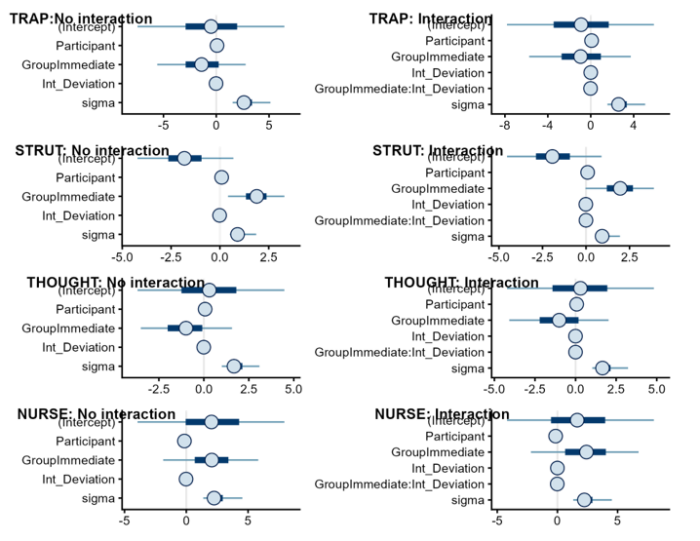
The standard deviation of interval between lessons effect on gains can be seen in Figure 1, where Int_Deviation is at around 0 on the GLMM plots. However, Group factors (seen in GroupImmediate) play a major part in the GLMM therefore there is an effect on the results, with GroupImmediate values between approximately -1 and 2.5 but notably not at 0. It should therefore be noted that the condition plays a part in gains from pretest to post-test scores, although it may be subject to other different effects.
CONCLUSION
Based on the results above, it can be concluded that delayed feedback is more likely than immediate feedback to result in perceptual acquisition of L2+ English vowels, as observed in the Group effects in the GLMMs. Furthermore, given the lack of interaction in the GLMMs between Group effects and the standard deviation of intervals between each participant's lesson completion, and the lack of effect in the t-tests, feedback timing is likely to have some effect, despite lower gains (or even losses for the immediate group) if learners cram, or if they are absent. However, the effect on learning gains for individual vowels due to the standard deviation of interval between lessons can be said to have moderate evidence base against interaction, with Bayes Factors well below the ceiling threshold of 1/3 as recommended by Norouzian et al. (2019). Therefore, while the feedback timing of groups did not have a large effect upon t-scores, the Group factor did account for differences in the GLMMs, much more than the standard deviation of lesson intervals.
Regarding individual vowels, it may be seen that gains were readily observed in TRAP (/æ/) and THOUGHT (/ɔː/) differences, whereas a very small between-groups difference was observed for NURSE (/ɜː/) and losses for both groups with STRUT (/ʌ/). Due to the more peripheral positions in the vowel space of TRAP and THOUGHT, and the more central positions of STRUT and NURSE, it may be concluded that the Natural Referent Vowel framework (Polka & Bohn, 2011) is supported, albeit tentatively due to the relatively small group size and the attendance issues during the study period.
DISCUSSION
The results in this study are important for teachers and potentially also TELL materials developers. Feedback modality timing is important and can contribute to rate of acquisition, however it is important to acknowledge classroom realities: learner absences and failure to make up missed work, or not sufficiently spacing missed work, result in cramming. Such cramming of learning activities can turn planned, pedagogically-sound activities into unsound learning practices. The results and conclusion therefore must be interpreted on a case-by-case basis due to potential differences between teaching and learning contexts. However, ecologically valid results can contribute to the development of knowledge in the SLA and language teaching fields, less through an approach combining findings from several contexts, which may allow for consideration of how and when feedback timing has an effect, and with which types of populations.
In the advent of a global pandemic, absence from class and incomplete hyflex learning activities is likely to be an increasing experience for all educators including language teachers. Absence, is of course, a factor in language learning, because it results in a lack of exposure to the target language, whether in-person, remote synchronous or asynchronous as in distance and blended learning. Furthermore, even if learners make up incomplete tasks, there may be cramming effects, resulting in low gains. In sum, disturbed and/or disrupted exposure to a language is detrimental to its acquisition. However, more research is necessary, and therefore encouraged, in order to investigate the size of any effects, in more usual class attendance situations.
Limitations
Participant attendance greatly affects just how generalizable the findings are across different populations. However, attendance in class cannot be guaranteed, especially when COVID isolation is considered. A further limitation of the current study is that a delayed post-test could not feasibly be carried out. Participant attrition can be a serious issue when working with samples from intact classes, and this is compounded by pandemic situations, due to difficulties in attendance due to infection with a highly contagious disease. The current study was conducted during the pandemic, at a time when in-class teaching with hybrid teaching for those unable to attend was encouraged. However, COVID-19 infection - even when not lethal - can be debilitating, and certainly in 'mild' cases leaves sufferers fatigued. As such, participants infected with COVID were unable, or understandably unmotivated to complete language learning exercises. Additionally, some language learners are more consistent with attendance than others for myriad reasons, which can, again be a factor in participant attrition with intact classes, particularly for completing testing sessions. Furthermore, due to participant attrition, a large sample size could not be maintained. While Bayesian methods are used to mitigate against small sample size (due to the central limit theorem not applying to Bayesian statistics), a larger sample may have resulted in more granularity in the data, thus being more informative. However, the ecological validity of the study being conducted in a classroom means that the transferability of findings is possible, and that the methodology can be repeated across contexts and extended further.
Address for correspondence: [email protected]
REFERENCES
Archangeli, D.B. 1999. Introducing optimality theory. Annual Review of Anthropology. [Online]. 28(1), pp.531-552. [Accessed 1 December 2024]. Available from: https://doi.org/10.1146/annurev.anthro.28.1.531.
Baese-Berk, M.M. 2019. Interactions between speech perception and production during learning of novel phonemic categories. Attention, Perception, & Psychophysics. [Online]. 81(4), pp.981–1005.[Accessed 1 December 2024]. Available from: https://doi.org/10.3758/s13414-019-01725-4.
Baker, W., Trofimovich, P., Mack, M. and Flege, J.E. 2002. The effect of perceived phonetic similarity on non-native sound learning by children and adults. In: Proceedings of the 26th annual Boston University Conference on Language Development, Boston University. Somerville, MA: Cascadilla Press, pp.36–47. [Accessed 1 December 2024]. Available from: https://www.paveltrofimovich.ca/wp-content/uploads/2021/07/Baker_et_al_2002.pdf.
Best, C.T. 1995. A direct realist view of cross-language speech perception. In: Strange, W. ed. Speech Perception and Linguistic Experience. Timonium, MD: York Press, pp.171–206.
Best, C.T. and Tyler, M.D. 2007. Nonnative and second-language speech perception: Commonalities and complementarities. In: Bohn, O.-S. and Munro, M.J. eds. Language experience in second language speech learning: In honor of James Emil Flege. Amsterdam: John Benjamins Publishing Company (Language Learning & Language Teaching), pp.13–34. [Accessed 1 December 2024]. Available from: https://doi.org/10.1075/lllt.17.07bes.
Bohn, O.-S. and Best, C.T. 2012. Native-language phonetic and phonological influences on perception of American English approximants by Danish and German listeners. Journal of Phonetics. [Online]. 40, pp.109–128. Available from: https://doi.org/10.1016/j.wocn.2011.08.002
Bundgaard-Nielsen, R.L. Best, C.T., Kroos, C. and Tyler, M.D. 2012. Second language learners’ vocabulary expansion is associated with improved second language vowel intelligibility. Applied Psycholinguistics. [Online]. 33(3), pp.643–664. [Accessed 1 December 2024]. Available from: https://doi.org/10.1017/S0142716411000518.
Bundgaard-Nielsen, R.L., Best, C.T. and Tyler, M.D. 2011. Vocabulary size is associated with second-language vowel perception performance in adult learners. Studies in Second Language Acquisition. [Online]. 33(3), pp.433–461. [Accessed 1 December 2024]. Available from: https://doi.org/10.1017/S0272263111000040.
Canals, L., Granena, G., Yilmaz, Y. and Malicka, A. .2020. Second language learners’ and teachers’ perceptions of delayed immediate corrective feedback in an asynchronous online setting: an exploratory study. TESL Canada Journal. [Online]. 37(2), pp.181–209. [Accessed 1 December 2024]. Available from: https://doi.org/10.18806/tesl.v37i2.1336.
Cárdenas-Claros, M.S. 2020. Conceptualizing feedback in computer-based L2 language listening. Computer Assisted Language Learning. [Online]. 35(5–6), pp.1168–1193. [Accessed 1 December 2024]. Available from: https://doi.org/10.1080/09588221.2020.1774615.
Crain, S., Koring, L. and Thornton, R. 2017. Language acquisition from a biolinguistic perspective. Neuroscience & Biobehavioral Reviews. [Online]. 81, pp.120–149. [Accessed 1 December 2024]. Available from: https://doi.org/10.1016/j.neubiorev.2016.09.004.
Escudero, P. 2005 Linguistic perception and second language acquisition: explaining the attainment of optimal phonological categorization. Ph.D. thesis, LOT.
Escudero, P. and Williams, D. 2014. Distributional learning has immediate and long-lasting effects. Cognition. [Online]. 133(2), pp.408–413. Available at: https://doi.org/10.1016/j.cognition.2014.07.002.
Faris, M.M., Best, C.T. and Tyler, M.D. 2018. Discrimination of uncategorised non-native vowel contrasts is modulated by perceived overlap with native phonological categories. [Online]. Journal of Phonetics, 70, pp.1–19. [Accessed 1 December 2024]. Available from: https://doi.org/10.1016/j.wocn.2018.05.003.
Felker, E., Broersma, M. and Ernestus, M. 2021. The role of corrective feedback and lexical guidance in perceptual learning of a novel L2 accent in dialogue. Applied Psycholinguistics, 42(4), pp.1029–1055. Available at: https://doi.org/10.1017/s0142716421000205.
Felker, E., Ernestus, M. and Broersma, M. .2019. Lexically guided perceptual learning of a vowel shift in an interactive L2 listening context. In: Interspeech 2019, 15-19 September 2019, Graz, Austria. ISCA, pp.3123–3127. [Accessed 1 December 2024]. Available from: https://doi.org/10.21437/Interspeech.2019-1414.
Fiorella, L., Vogel-Walcutt, J. and Schatz, S. 2012. Applying the modality principle to real-time feedback and the acquisition of higher-order cognitive skills. Educational Technology Research and Development. [Online]. 60, pp.223–238. [Accessed 1 December 2024]. Available from: https://doi.org/10.1007/s11423-011-9218-1.
Flege, J.E. and Bohn, O-S. 2021. The revised speech learning model. In: Wayland, R. ed. Second language speech learning: Theoretical and empirical progress. Cambridge University Press, pp.3–83. [Accessed 1 December 2024]. Available from: https://doi.org/10.1017/9781108886901.002.
Flege, J.E. (1995) Second-language speech learning: Theory, findings, and problems. In: Strange, W. ed. Speech Perception and Linguistic Experience. Timonium, MD: York Press, pp.229–273.
Flege, J.E. and MacKay, I.R.A. (2004) Perceiving vowels in a second language. Studies in Second Language Acquisition. [Online]. 26(01), pp.1–34. [Accessed 1 December 2024]. Available from: https://doi.org/10.1017/S0272263104026117.
Hayes-Harb, R. and Barrios, S. 2021. The influence of orthography in second language phonological acquisition. Language Teaching. [Online]. 54, pp.297–326. [Accessed 1 December 2024]. Available from: https://doi.org/10.1017/S0261444820000658
Horwitz, E.K., Horwitz, M.B. and Cope, J. 1986. Foreign language classroom anxiety. The Modern Language Journal. [Online]. 70, pp.125–132. [Accessed 1 December 2024]. Available from:https://doi.org/10.1111/j.1540-4781.1986.tb05256.x
Ingram, J.C. and Park, S-G. 1997. Cross-language vowel perception and production by Japanese and Korean learners of English, Journal of Phonetics. [Online]. 25(3), pp.343–370. [Accessed 1 December 2024]. Available from: https://doi.org/10.1006/jpho.1997.0048.
Jenkins, J. 2000. The phonology of English as an international language: new models, new norms, new goals. Oxford: Oxford Univ. Press.
Johnson, C.I. and Maraffino, M.D. 2021. The feedback principle in multimedia learning. In: Mayer, R.E. and Fiorella, L. eds. The Cambridge handbook of multimedia learning. 3rd edn. Cambridge University Press, p. 34.1-34.64. Available from: https://doi.org/10.1017/9781108894333.
Lee, A.H. and Lyster, R. 2016. Effects of different types of corrective feedback on receptive skills in a second language: a speech perception training study. Language Learning. [Online]. 66, pp.809–833. [Accessed 1 December 2024]. Available from: https://doi.org/10.1111/lang.12167
Lyster, R. and Ranta, L. 2013. Counterpoint piece: the case for variety in corrective feedback research. Studies in Second Language Acquisition. [Online]. 35(1), pp.167–184. [Accessed 1 December 2024]. Available from: https://doi.org/10.1017/S027226311200071X.
Norouzian, R, de Miranda, M and Plonsky, L. 2019. A Bayesian approach to measuring evidence in L2 research: an empirical investigation. The Modern Language Journal. [Online]. 103(1), pp.248–261. [Accessed 1 December 2024]. Available from: https://doi.org/10.1111/modl.12543.
Pienemann, M. 1999. Language processing and second language development: Processability theory. Amsterdam: John-Benjamins.
Polka, L. and Bohn, O-S. 2011. Natural Referent Vowel (NRV) framework: An emerging view of early phonetic development’, Journal of Phonetics. [Online]. 39, pp.467–478. [Accessed 1 December 2024]. Available from: https://doi.org/10.1016/j.wocn.2010.08.007
Prince, A. and Smolensky, P. 2002. Constraint Interaction in Generative Grammar. Rutgers University, p. 262.
Rassaei, E. 2019. Computer-mediated text-based and audio-based corrective feedback, perceptual style and L2 development. System. [Online]. 82, pp.97–110. [Accessed 1 December 2024]. Available from: https://doi.org/10.1016/j.system.2019.03.004.
Rebuck, M. 2008. The effect of excessively difficult listening lessons on motivation and the influence of authentic listening as a “lesson-selling” tag. JALT Journal. [Online]. 30(2), pp. 197-222. [Accessed 1 December 2024]. Available from: https://doi.org/10.37546/JALTJJ30.2-3.
Rukthong, A and Brunfaut, T. 2020. Is anybody listening? The nature of second language listening in integrated listening-to-summarize tasks. Language Testing. [Online]. 37(1), pp.31–53. [Accessed 1 December 2024]. Available from: https://doi.org/10.1177/0265532219871470.
Ryan, R.M. and Deci, E.L. 2017. Self-determination theory: basic psychological needs in motivation, development, and wellness. New York: The Guildford Press.
Schmidt, R.W. 1990. The role of consciousness in second language learning. Applied Linguistics, 11(2), pp.129–158. [Accessed 1 December 2024]. Available from: https://doi.org/10.1093/applin/11.2.129.
Sweller, J. Ayres, P. and Kalyuga, S. 2011. Cognitive Load Theory. New York, NY: Springer New York. [Accessed 1 December 2024]. Available from: https://doi.org/10.1007/978-1-4419-8126-4.
Tyler, M.D. 2019. PAM-L2 and phonological category acquisition in the foreign language classroom. In: Nyvad, A.M., Hejná, M., Højen, A., Jespersen, A.B., Sørensen, M.H. eds. A sound approach to language matters: in honor of Ocke-Schwen Bohn. Aarhus University, pp.607–630.
Vafaee, P. and Suzuki, Y. 2020 The relative significance of syntactic knowledge and vocabulary knowledge in second language listening ability. Studies in Second Language Acquisition. [Online]. 42(2), pp.383–410. [Accessed 1 December 2024]. Available from: https://doi.org/10.1017/S0272263119000676.
Van Leussen, J-W. and Escudero, P. 2015. Learning to perceive and recognize a second language: the L2LP model revised. Frontiers in Psychology. [Online]. 6. [Accessed 1 December 2024]. Available from: https://doi.org/10.3389/fpsyg.2015.01000.
Warschauer, M. and Healey, D. 1998. Computers and language learning: an overview. Language Teaching. [Online]. 31, pp.57–71. [Accessed 1 December 2024]. Available from: https://doi.org/10.1017/S0261444800012970.
Wang, Y.H. and Young, S.S-C. 2012. Exploring young and adult learners’ perceptions of corrective feedback in ASR-based CALL system. British Journal of Educational Technology. [Online]. 43, pp.E77–E80. [Accessed 1 December 2024]. Available from: https://doi.org/10.1111/j.1467-8535.2011.01275.x.
Winn, M.B. and Teece, K.H. 2021. Listening effort is not the same as speech intelligibility score. Trends in Hearing. [Online]. 25, pp.1-26. [Accessed 1 December 2024]. Available from: https://doi.org/10.1177/23312165211027688.
Zhang, W. and Liao, Y. 2023. The role of auditory processing in L2 vowel learning: evidence from recasts. Humanities and Social Sciences Communications. [Online]. 10(1), pp.1–14. [Accessed 1 December 2024]. Available from:https://doi.org/10.1057/s41599-023-02001-5.
Appendix: YouTube video list
Lesson 1
IntuitInc. 2012. Lean Startup Lessons: Test Before you Build. [Online]. [Accessed 1 December 2024]. Available from:https://www.youtube.com/watch?v=KqtVWzwIfso
Lesson 2
Startup Amsterdam. 2016. How to give the perfect pitch - with TedX speech coach David Beckett - Young Creators Summit 2016. [Online]. [Accessed 1 December 2024]. Available from: https://www.youtube.com/watch?v=Njh3rKoGKBo
Lesson 3
Dartmouth. 2018. How Playing Games Can Change the World. [Online]. [Accessed 1 December 2024]. Available from:https://www.youtube.com/watch?v=h0u4accv15c
Lesson 4
Wired. 2014. Wired by design: a game designer explains the counterintuitive secret to fun. [Online]. [Accessed 1 December 2024]. Available from: https://www.youtube.com/watch?v=78rPt0RsosQ