
The ADHD learner, time perception, and the listening skill in EAP: decoding the temporal rules of auditory processing of phonological information to rethink practices for an inclusive classroom
Charles Marshall
School of Modern Languages and Cultures, University of Glasgow, UK
ABSTRACT
This article aims to explore the complexity behind the potential challenges that some students have in English for Academic Purposes (EAP) classrooms and contexts regarding listening skills. The developing argument comes from a perspective that not all listeners will process auditory information identically due to neurological differences (neurodiversity) and therefore that we should adjust our practices with divergent listeners as learners in mind. Part of this premise will be defended by advocating for the importance of scholarship of teaching and learning that draws from disciplines beyond what we might usually be comfortable with, providing insights that can help us view language problems from novel angles. Examining the neuroscience literature, unique properties of the ADHD-influenced brain will be identified and while doing so, the features that impact upon students’ listening, in the EAP and HE context, will be discussed. It will be suggested that time perception differences may account for the problems ADHD listeners might have in processing phonological information and thus auditory information as speech. In arguing for the existence of a temporal dimension to the rule-based nature of speech and the differences diverse learners may have with that temporal processing, we can think about the effectiveness of our practices and consider ways to adapt or transform them according to those temporal principles.
Although EAP is used as an example practice context, it is hoped the insights from this discussion can be useful to other language learning and teaching fields.
Keywords: Executive functioning, time perception, neuroplasticity, remediation, auditory processing
INTRODUCTION
What is ADHD?
Before we discuss the prevalence of ADHD worldwide and the possibility of a reasonable percentage of our own students in EAP classrooms possessing traits, it is necessary to provide a brief description of the condition. According to the American Psychiatric Association (APA), producers of the Diagnostic and Statistical Manual of Mental Disorders, Fifth Edition (DSM-5), Attention Deficit Hyperactivity Disorder (ADHD) is characterised by ‘symptoms that include inattention (not being able to keep focus), hyperactivity (excess movement that is not fitting to the setting) and impulsivity (hasty acts that occur in the moment without thought)’ (APA, 2023). Similarly, other descriptions in the literature describe the condition in relation to effects on the everyday functioning of individuals, namely how, for example, poor impulse control and inattention affect a person’s ability to self-regulate their actions and behaviours and to control their executive functions necessary to perform tasks (e.g., Barkley, 2014).
Executive Functioning (EF) issues in adults with ADHD may be understood as ‘a difficulty in self-management, including organization, planning, initiating and completing on a timely basis, tracking and shifting tasks, self-monitoring, and self-inhibition’ (Solanto, 2015, p. 256). The causes of the condition, as seen in EF behaviours, may be found in the neurological processes that regulate those cognitive and physical acts. ADHD is therefore described in the literature as a neuro-developmental condition stemming from various parts of the brain and affecting others, and those responsible for the EFs (Arnsten, 2009; Qiu et al., 2009). One example region of the brain that may affect EFs is the temporal and parietal lobes and prefrontal cortex (PFC) as they control mechanisms for attention. They are responsible for ‘orienting attentional resources in time/space’ (Arnsten, 2009, p. 33). Another example is that of the basal ganglia responsible for impulse control (Qiu et al. 2009). The cerebellum is another region that if impaired can affect sensory processing (Petacchi, 2005), and possibly temporal processing alongside other regions of the brain (Toplak et al., 2017).
ADHD has often been connected to deficiencies in the dopaminergic system of the brain (e.g., Swanson, et al., 2007), responsible for regulating mood, emotions and delaying reward (Calabresi et al., 2007; Baik, 2020). This system, then, may have an effect on normal functioning in various settings, including in educational contexts in which problems with regulating one’s behaviour can have detrimental effects. In simplest of terms, if not given reward, a dopamine hit, students with ADHD are unlikely to continue with an activity that is not providing that feel good factor. Deficiencies in the reward system may then go on to present as ‘multiple addictive, impulsive, and compulsive behaviors’ (Blum et al., 2008, p. 894) that may even be perceived as bad behaviour. Despite this, it is important not to reduce the causes of ADHD simply to dysregulation of the dopaminergic system but rather, as a neuro-developmental disorder that includes other brain regions and even brain structure itself (del Campo et al., 2013). The complexity of the condition in terms of its physiological bases reflects its intricate myriads of effects on one’s daily life.
Prevalence in adults worldwide
Various studies have been conducted to give estimates as to the prevalence of ADHD in young and mature adults worldwide. One systematic review suggested a figure of up to 363.33 million or a percentage among those over 18 years old of 6.76% symptomatic adults in 2020, despite inconsistencies in criteria for identifying the condition (Song et al., 2021). Those that were diagnosed as a child and symptoms continuing into adulthood stands at a possible 2.58% (Song et al. 2021). The problem with estimates such as these is that the methods used to diagnose adulthood ADHD, focusing mainly on self-reporting and a DSM symptom threshold of six, are different from those in childhood that require a higher threshold and observation of behaviour (Sibley et al. 2016). Those adults with ADHD since childhood were often found to underreport their symptoms despite observers in, say, the family suggesting the continuance of them (Sibley et al. 2016). Sibley, et al. (2017) using parent and self-reporting measures found that around 60% of adults diagnosed as children were exhibiting signs of ADHD in adulthood. In way of a comparison a recent systematic review and meta-analysis suggested the percentage among children and adolescents at around 7.6% and 5.6% respectively (Salari et al., 2023). Studies suggest that the disorder may change or fluctuate across the life-cycle with differing symptoms and intensity as we age and encounter various life challenges (e.g., Sibley, et al. 2024). However, there is some evidence to suggest that, whilst partial remission can occur, complete remission seems unlikely in the majority of cases (Sibley, et al. 2022).
The argument for ADHD persistence into adulthood is strong, increasing the possibility of learners over the age of 18 experiencing symptoms in various contexts whether formally diagnosed or not.
Regional prevalence
If practising EAP in Anglo-phone countries, a large amount of the EAP cohort is from East Asia, the likelihood of receiving a significant percentage of adults in our classes with persistent and symptomatic ADHD is high. The number of Chinese students, in particular, attending UK universities, even during the Covid-19 restrictions in 2021-2022, stood at 151,690 from the mainland and 17,630 from Hong Kong (Universities UK, 2023). This would make Chinese students the majority of any national group from outside the UK, 22.3% of international students (Study In The UK, 2023).
A meta-analysis to estimate the prevalence of ADHD among children and adolescents in China yielded similar figures to that of the worldwide percentage standing at 6.26% (Wang, et al., 2017). For adults, the lack of studies, particularly on in the mainland, can only allow us to speculate as to its prevalence among that age group. Mak et al., (2020) conducting a small-scale study in Hong Kong, suggest a high possibility of persistence (83.1%) of ADHD into adulthood with diagnoses made utilising DSM-5 criteria. This could then equate to similar adult prevalence rates found elsewhere.
ADHD and listening
In this essay I will discuss how our attention to the problems of ADHD learners in developing their listening skills in the context of EAP learning environments is already lacking but any adjustment to our practices needs to be informed by explorations into the neuroscience literature that may provide evidence to support future pedagogical choices. Gaining a deeper understanding as to the mechanisms behind observed differences in listening may give us the knowledge that can greatly improve the learning experience of our students.
The literature to date on listening and listening skills development for students with ADHD in EAP contexts is mostly absent and in other EFL/ESOL contexts is particularly scant. Some, however, e.g., Kałdonek-Crnjaković (2022) have attempted to address this in EFL with a small-scale study focussing on all four language skills. The findings are consistent with those that are centred on L1 language learning issues e.g., McInnes et al., (2003) that problems of inattention, distraction and working memory are implicated in the successful development of listening abilities and skills. Whilst one does not doubt the role of attentional and working memory influence on listening, I will argue the case that timing mechanisms in the brain may actually be behind those executive function problems (see Toplak and Tannock, 2005) and if we focus our attention to those mechanisms rather than to behaviours influenced by them, we could potentially not only help our students improve their listening through remediation practices focused on the temporal features of auditory information, but also allow them to improve upon other cognitive functions important in managing their own learning.
EVALUATING EAP PRACTICES FOR THE ADHD LISTENER
Listening in EAP contexts
The contexts and scenarios in which our students are engaged in listening is quite clearly varied and nuanced depending on their points of contact with peers, lecturers and others, and the activities practised in those interactions. One might be familiar with the more structured activities such receptive skills practice in class, or active listening in seminar/discussion skills development, but listening in EAP can also include tutorials, and out of class project work. Much of what we may focus on in class, in terms of listening skills in higher education contexts such as in lectures, is the development of strategies to enable the student to better process audio information (Field, 2011, p. 103). Whilst these strategies may be helpful, alone they do not directly address problems of audio processing, possibly stemming from brain differences such as those mentioned above and those below regarding time perception.
Listening in lectures
As an example of strategies to develop listening skills, I will use the lecture as a context in which they are practised. This is partly due to lectures still being a principal modality for communicating academic content in universities, also because, anecdotally, my own students, over the years, have commented on their struggles in that situation despite access to recordings.
Lectures require different attention and skills to other listening activities, one such skill would be that which requires the listener to ‘concentrate on and understand long stretches of talk without the opportunity of engaging in the facilitating functions of interactive discourse, such as asking for repetition, negotiating meaning, using repair strategies, etc’ (Flowerdew, 1994, p. 11). As we can already see, this skill is difficult for many listeners but for the ADHD listener it would be potentially more challenging due to problems of regulating attention. This is compounded with the need to practise the skill of notetaking whilst being exposed to other media beyond the spoken word, such as visual information (p. 12). The combination of information, both spoken and written word, that is essentially the same information may cause what is referred to as a redundancy effect, which means that extra pressure is passed to cognitive mechanisms like short term memory, although that information is simply duplicated through each of those modes, thus seemingly unnecessary, putting strain on the learner (Sweller et al., 2011).
Academic listening skills according to Flowerdew’s (1994, p. 9) review of the literature, have been identified as requiring both ‘linguistic processing’ of information and ‘application of the results of this linguistic processing to background knowledge and context.’ Flowerdew (1994, p. 9) argues that the processes are rather more complex than had been observed and any hierarchical prioritisation, a view that uncritically interprets linguistic processing as ‘low level’ or ‘bottom up’ and that the broader contextual understanding as ‘high level’ or ‘top down,’ should be questioned. Progressively more current practice orientated publications such as Alexander et al., (2019) present this view. Flowerdew (p. 9) claims there is an assumption, that, due to the language level of our students, we will tend to focus our attention more on so-called higher-level processing. If attention to linguistic processing is piecemeal or based solely on lexical and semantic relations, then those efforts may be less successful without phonological processing. De Chazal’s (2014) suggestion of five tasks to support students in preparation for lectures is what many of us (EAP practitioners) are accustomed to utilising whether in teaching or in material design, but sub tasks within each task should incorporate a degree of phonological awareness and practice appropriate to the aims of the broader task. Without phonological awareness, the ability to predict upcoming information, from phoneme to phoneme, to syllable and beyond will be affected.
Five tasks suggested by De Chazal (2014)
- Task 1: Preparing for the lecture by reading a pre-lecture handout on the lecture topic
- Task 2: Listening for essential factual information
- Task 3: Academic language: a focused study of key language in the lecture, such as the language of association, speculation, and degree of certainty
- Task 4: Listening for association and evaluation in the lecture
- Task 5: Reprocessing information from a lecture using notes
As an example, ‘reprocessing information from notes’ would assume that information from the lecture was successfully processed in real time during the lecture. Or if we are to focus on lexical items that represent key language, language of association etc, then we will need to break down their phonological segments and to treat such items as auditory sequences, in ‘chunks’, that possess waveform qualities with distinctive transitions (see Tallal, 2004). To enable students to perform those tasks, attention to phonological processing is unavoidable. Much research to date (e.g., Raiker et al., 2017) has implicated problems of phonological processing with receptive abilities in those with ADHD, making associations with attentional traits and working memory. Few have explored the role of time in processing that information beyond possible associations with time perception and attention (see Gooch et al., 2010). The possible mechanisms behind those associations will be further discussed below.
Decoding the message: the temporal dimension
Whilst we may spend class time raising awareness of lexical and phonological features students will encounter in lectures that can help students to predict, anticipate and respond (take notes) effectively, the so-called ‘lower level’ processing such as phoneme articulation, noticing stress or intonation might not be low enough. ‘Cracking the code of speech’ as Graham (2011, p. 116) puts it, is reliant on rethinking, adapting and adjusting strategies so that they are indeed focused on breaking that code. The code may be based on information below that of simple phonemic awareness and practice but rather a temporal dimension that allows for effective phonetic processing. This might include attention to auditory sequential processing through identifying the rule-based nature of acoustic information as mentioned above (Tallal, 2004). Those rules might be based on timing mechanisms in an utterance. Strategies that do not home in on the temporal fundamental of speech processing may ‘miss a trick’ in terms of enabling students to listen effectively in lectures especially when considering that there will likely be little in the way of support for ‘the processing difficulties of the second language listeners in the audience’ (Field, 2011, p. 102). We need to think about those strategies in terms of assumptions as to the extent to which the students in front of us have control of their temporal domain and thus managing information that needs processing in real time. The processing of auditory information may then be a matter of time (Tallal, 2004).
THE NEURO-SCIENCE LITERATURE AND THE PROBLEM OF TIME PERCEPTION
Time blindness?
Those with ADHD have reported and observed by peers and family members to possess inaccuracies in sensing time, presented in the form of impulsive responses, lack of patience, and tardiness (Topiak and Tannock, 2005; Barkley, 1997) but do these observations have a basis in the neuroscience? Personal accounts and observations may use terminology such as time blindness as is encountered on social media and in non-academic publications. A simple Google search of ADHD and time blindness brings an array of journalistic articles and public facing medical websites reporting on the alleged existence of the phenomenon especially among those with ADHD. YouTube and Tik-Tok is busy with ADHD creators describing their experiences of time-blindness, such as being constantly late for appointments, getting lost in a stimulating activity until the early hours on a weekday, when one has engagements in the morning. So, are people with ADHD actually perceiving time differently? I, the author, have ADHD and an example of my own experience of the time phenomenon goes something like this: I get up and have coffee, listen to a news podcast (miss most of it), sip hot coffee once, sip cold coffee the second time. In my mind only a few minutes have passed, but the podcast has finished, and 30 actual minutes have elapsed and now I’m late for the train. I was distracted, maybe, although I can’t for the life of me remember what by. In other situations, it seems, distractions are not directly to blame, as the following example may suggest. I leave my house for the train which leaves at 07:01, so I must leave my house 10 minutes beforehand to not miss it. I leave 20 minutes before due to a panic I have every day, that is, how long does 10 minutes take?
And how is this connected to processing auditory information and listening?
TIME PERCEPTION
How is so-called time-blindness connected to processing auditory information and listening? The answer may rest in time perception. Time perception refers to the effective estimation, discrimination, reproduction and production of time intervals providing an ‘ability to predict, anticipate, and respond to upcoming information’ (Nejati and Yazdani, 2020, p. 900). The above examples of time-blindness may be considered relatively normal but the extent and frequency they occur, towards disorder level, may negatively affect one’s basic executive functioning (Barkley, 1997; Smith et al., 2002) necessary to perform the four language skills effectively. And, particularly, as argued in this article, deficits in temporal processing likely interrupt the student’s effective listening abilities and listening skills development. In reviewing the neuroscience, differences in time perception, an aspect of temporal processing along with motor-timing, between those described as normal, in terms of time perception, and those with ADHD have been identified and suggested as heavily influential on the presentation of the symptoms of ADHD centred on executive functioning (Smith et al., 2002; Nejati and Yazdani, 2020). Some would go further to suggest that such malfunctions in temporal control may produce ‘cascading effects’ onto ‘other cognitive mechanisms’ such as memory (Toplak and Tannock, 2005, p. 651).
Measuring time perception
The most common measurements utilised in the empirical literature are estimation and discrimination. Estimation requires that temporal information provided in time intervals is accurately estimated, and verbally reported, in terms of is duration by the recipient in a form of audio and/or visual stimuli (Barkley et al., 2001). Despite the fact that audio and visual stimuli utilise different cognitive mechanisms, deficits in temporal processing of information from those sources equally occur (Nejati and Yazdani, 2020). Whereas estimation requires the participant to estimate how long a particular interval was duration discrimination “involves the comparison of two brief intervals similar in duration (such as, 500ms vs. 600ms to determine which is longest or shortest” (Toplak and Tannock, 2005, p. 640).
Results from estimation and discrimination studies show not so dissimilar findings. Both Toplak and Tannock (2005) and Anobile et al., (2022) found that participants with ADHD failed to discriminate effectively in the millisecond range below 1000ms. Inaccuracy and imprecision were also found in time estimation tasks as suggested by Walg et al., (2017). A meta-analysis (Zheng et al., 2020) of 27 empirical studies claimed similar findings in terms of precision and accuracy and a tendency among participants with ADHD to overestimate time intervals.
Reproduction tasks require that participants reproduce or replicate a duration of time after being exposed to it (Barkley et al., 2001, p. 352). Results from such tasks indicate that ADHD participants produce accuracy and precision errors especially when increasing the duration (e.g., Dolek et al., 2021; Barkley et al., 2001). It is argued (e.g., Anobile et al., 2022) that reproduction tasks put more emphasis on working memory than simple estimation and discrimination tasks, as they tend to focus on intervals of over 1000ms, which is the supposed threshold for employing the cognitive mechanism (Toplak and Tannock, 2005).
A ‘pure’ time deficit and the ‘internal clock’
Smith et al., (2002), utilising a discrimination task, found that a sample of children with ADHD needed 50 ms longer than a non-ADHD to discriminate between intervals, concluding that those with the disorder may possess ‘a perceptual deficit of time discrimination’ (p. 529). This 50ms deviation, when exposed to intervals of hundreds of milliseconds rather than longer intervals, can be indicative of what Anobile et al., (2022) claim in relation to loading on working memory, that those less than 1000ms do not activate the cognitive processes necessary to engage it, suggesting a pure time deficit (Smith, et al., 2002, p. 530). Walg et al., (2015) had similar findings but not in terms of overestimating the shorter intervals but rather an inefficiency in shifting between intervals of different durations whilst still over-estimating longer durations. Using a retrospective time estimation task, one that requires memory and ‘passive information holding’ as opposed to a prospective task that would require ‘active online processing’ (Nejati and Yazdani, 2020, p. 911), Walg et al., (2017) measured noticeable over-estimations among the ADHD sample suggesting ‘a lower –processing speed’ (p. 1181). This phenomenon cannot be attributed to working memory processes as no differences were found with the control group when testing explicitly for that cognitive function, but rather for another timing mechanism brought into play due to the retrospective task not focusing on the ‘passage of time’ itself (p. 1183). For Walg et al., (2017) the actual mechanism responsible is not certain but processing speeds may be attributable to the ‘internal clock’ or ‘pacemaker’ being faster in those with ADHD (p. 1183). The faster clock committing ‘over-estimation errors’ is clearly an issue when considering the need for accuracy and preciseness (Anobile et al., 2022).
TEMPORAL PROCESSING AND INFORMATION PROCESSING: A PROBLEM FOR LISTENING
Language development and time perception
Using the clock hypothesis as a basis, Wearden’s (2008) review of literature on time perception suggested a plausible link between it and certain ‘language disorders’ e.g., dyslexia or aphasia. This was found to be most prevalent in ‘the ability to discriminate time intervals’ and ‘the perception and control of speech’ and may be connected to problems with ‘rapid temporal processing’ (p. 162). This active, online, in the moment processing is one I have already touched on above and is necessarily activated in certain language acts. Wearden (p. 163) cites research done on conversation as an example and how it requires ‘turn-taking’ and ‘smooth transitions from the role of speaker and listener.’ Such situational need for processing language may clearly affect those with particular language disorders but also those with ADHD as co-morbid disorders and learning difficulties are relatively prevalent among those who exhibit attention deficit traits (Brown, 2000). Indeed, such conditions are not mutually exclusive; those with ADHD may also be dyslexic. At the same time, some broader traits related more typically to dyslexia can also present in those with ADHD, even if dyslexia is not diagnosed, such as late language development (Smith et al., 2002, p. 537).
Temporal and phonological information processing
Despite a lack of an extensive literature, the connection between language developmental issues (e.g., dyslexia), ADHD, and temporal processing can, at least, be inferred at this point. What can be suggested from this, however, is that receptive and productive language skills may be impeded both in L1 And L2 users. Processing is further affected when considering that the target language is a second or additional language. A starting point may be in the acknowledgment of the temporally influenced nature of the processing of speech and how that affects the information processing. Again, we may return to Smith et al., (2002) description of a 50ms + inaccuracy in discriminating between intervals. The 50ms difference might seem insignificant (possibly add more for L2 learners) but not when we consider the basic units of speech that help convey meaning, thus they contain information, namely, phonemes. Smith et al., (2002, p. 537) claim that the typical phoneme will only be produced for 50ms, therefore, the listener will need to process it at and around that time. Clearly, those who cannot process that phoneme in the target time will likely not process its information and cause a domino effect on those that follow it.
The problem of processing speed is further elaborated on by Tallal (2004), again focusing more broadly on language and literacy disorders. Importantly, she connects the problem of time and speech perception with the need to recognise that ‘speech does not comprise random chunks of acoustic information but is organized in a rule-based sequential manner’ (p. 724). Phonological segments rarely stand alone in an utterance but rather form a part of a ‘sequential acoustic waveform’ with prominent transitions such as those that may occur when initiating a segment (p. 722), which may also be seen in those transitions to stressed syllables. Tallal (p. 722) uses the example of how attention to exaggeration of those acoustic changes during childhood language development trains the brain to fire acoustically sensitive neurons, in order to segment the ongoing waveform into recognisable patterns in time periods of milliseconds, allowing for accurate differentiation between phonemes, and in hundreds of milliseconds to approach multiple segments such as syllables. This would then further suggest that if one possesses a temporal processing deficit affecting their processing of auditory information then that will limit their ‘ability to predict, anticipate, and respond to upcoming information’ (Nejati and Yazdani, 2020, p. 900) necessary for effective listening.
NEUROPLASTICITY AND REMEDIATION
Phonemic awareness and auditory sequential processing
Language Learning Impairments (LLI), including dyslexia and certain speech impairments, have been found to be associated with ADHD (e.g., Martinusson and Tannock, 2006), whether causal in terms of factors relating to inattention or co-morbid conditions. As touched on above, attention to timing mechanisms as central to these impairments is relatively scant in the literature, however, evidence from targeted studies has shown a possible link between LLIs and such a mechanism. Results from this research indicate that those with LLIs, as opposed to those who do not, are inhibited in “ their ability to discriminate between and to produce speech sounds that are characterized by brief, rapidly successive acoustic changes, such as the brief formant transitions (40msec) preceding the steady-state portion of the vowel, which are the sole differentiating feature between syllables such as /ba/ and /da/” (Tallal, 2004, p. 722). Manipulation in the formant transitions, or ‘rapid acoustic changes in frequency and intensity,’ of those particular syllables, to lengthen the transition above 40 ms, allowed for improved discrimination among participants (Tallal, 2004, p. 723). Sensitivity to those transitions has even been found to be influential in identifying the place of articulation of a phoneme (Walley, and Carrell, 1983).
Neuroplasticity, prediction and sequence learning
Impairments in auditory sequential processing may well be connected to abnormalities in the neuronal/synaptic activity in the brain responsible for effective learning and memory (Mancini et al., 2022). ‘Neurons (also called neurones or nerve cells) are the fundamental units of the brain and nervous system, the cells responsible for receiving sensory input from the external world, for sending motor commands to our muscles, and for transforming and relaying the electrical signals at every step in between’ (Woodruff, 2023). Synapses are the ‘places where neurons connect and communicate with each other’ and effective communication between neurons requires chemical neurotransmitters sending signals across those synapses (Caire et al., 2023). Neuroplasticity has been described as ‘a process that involves adaptive structural and functional changes to the brain. It is defined as the ability of the nervous system to change its activity in response to intrinsic or extrinsic stimuli by reorganizing its structure, functions, or connections’ (Puderbaugh, 2023). Neurons and synapses play a central role in plasticity, in the form of creating new neurons and the passing of information between neurons and the strengthening of connections between neurons via stimulation of synapses is an important factor in learning (Galván, 2010).
Learning is dependent on our experiences and our environment and may differ in terms of timing as and when an episode occurs (Galván, 2010). Stimulation of those neuro circuits to enable learning in the form of input may then be only relatively successful depending on their experience of that input. Our case for those with ADHD has already been sketched above regarding control of their temporal domain. The suggestion unfolding here is that potential interventions to stimulate plasticity may be beneficial in gaining that control and thus enabling better prediction of upcoming information.
Spike-timing-dependent-synaptic learning is a mechanism for prediction plasticity that demonstrates the effect of relative timing between input and output spikes in a neuron. Input synapses to a neuron are strengthened, while output synapses are weakened, creating a window of plasticity ranging from -40 to +40 milliseconds. This predictive capability may facilitate direction selectivity. Evidence of this mechanism in action has only been established for visual stimuli, but it is plausible that it could also apply to auditory information. The 40-millisecond time window is crucial for comprehending how the rapid fluctuations in formant transitions affect the temporal order of continuous speech even over longer time intervals than in the tens of milliseconds (Tallal, 2004, p. 724-725). This is significant because:
Such a mechanism, when exposed to the rapid temporospectral changes that charcterize speech, would cause multiple neurons in the primary auditory cortex that fire simultaneously to bind together. Not only would such temporally contiguous, frequent patterns of feature activation build cell assemblies representing discrete phonemes, but such activity in one cortical circuit could, through converging projections, activate other cortical areas leading to a sequence of activations (p. 725).
If the different parts of this system are connected, then this could lead to the development of predictive rules for various phonological aspects of language, and even those of syntax (p. 725).
Adjusting and improving the rate of auditory sequential processing
Tallal’s work on adapting the above findings into models that incorporated the dynamics of temporal changes in the acoustic waveforms of speech, evolved into a training programme that ‘incorporated two 70-msec duration tones separated by a 500-msec silent inter-stimulus interval (ISI) between the end of the first tone and the beginning of the second tone in each sequence’ (Tallal, 2004, p. 723). Once the participant is familarised with this process, ‘the ISI between tones was systematically decreased for correct responses or increased for incorrect responses’ (p. 723). This would continue until an individual threshold for each participant was reached (p. 723). Such interventions and their subsequent findings, according to Tallal (2004, p. 723), suggested that there were individual differences in Rapid Auditory Processing (RAP) in early childhood could be influential in their language development over time (p. 723). In terms of phonological processing, ‘[e]arly auditory deficits, differences or experiences are likely to affect the sharpness of phonological representations that are established through experience-dependent learning in infancy, leaving a lasting effect of phonological impairment’ (Tallal, 2004, p. 724).
With such interventions, this improvement from hundreds of milliseconds down to tens of milliseconds, is of pronounced significance if we are to enable students to have more control of their temporal domain and thus their ability to predict, anticipate and respond to information that is at first phonological information. Moreover, if we are to suggest that the effects of control could limit the negative influence or ‘cascading effects’ on other cognitive functions (see Toplak and Tannock, 2005; Walg et al., 2017; Smith, 2002) then such remediation interventions can possibly have a greater influence on a successful learning experience.
DISCUSSION AND CONCLUSION: LANGUAGE TEACHING PROFESSIONALS AREN’T PSYCHIATRISTS BUT...
I believe that adapting and adjusting our practices in the ways described above can empower the listener to be able to thrive in a learning environment that on the face of it is far from conducive to nurturing neurodiverse brains. Examples of such interventions could be in awareness and practice of the temporal nature of transitions between phonemes to enhance a learner’s ability to predict upcoming phonological information. Tallal’s (2004) work on increasing and steadily decreasing thresholds in terms of milliseconds could in its basic principles be incorporated into tasks that require listening for key information or others that require rapid processing of phonological information. For example, stressed syllables in that information could be temporally manipulated in similar ways as is suggested in her work with keen attention to transitions into and out of the stressed vowel.
…we are linguists and educators
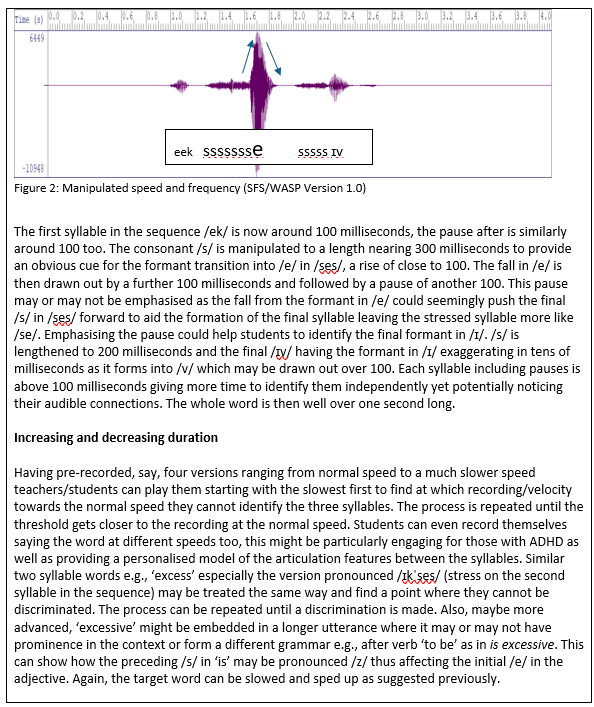
If we are to consider the neuro-science theory and a return to our familiar practice in language education, how can we imagine it applied to everyday teaching and learning? The activity below, still influenced by the theory above, describes a potential awareness raising activity that can exemplify the manipulation of the velocity of consonants, formant transitions of vowels and even ‘pauses’ to identify the wave form shape of phonetic connections in and between syllables and possible ways to practice.

The positives and potential pitfalls of interventions
Neuro-science informed intervention strategies, such as those suggested above, which can isolate the temporal aspects of the processing of audio information, might potentially help our students to learn to predict, anticipate and respond to upcoming information in rapid speech, typical in listening contexts such as lectures. The ability to predict subtle changes in sounds at the millisecond level will enable prediction of subsequent sounds and thus sequences across larger utterances. With regular creative and research informed interventions in the learning process, the processing of audio information may reach normal speed for those whose rate may be slower or variable depending on stimuli. We would also need to consider the necessary time and attention given to such activities, how they would fit into normal sessions and/or potentially modifying curriculum to allow for focused listening/phonology sessions as well as materials and strategies for autonomous learning. Further research needs to be done to factor in the actuality that our learners are second language learners and the problems of processing that individuals in that cohort may have, with or without ADHD, not to mention other auditory processing differences or difficulties.
Interventions may also be problematic if we are to assume that many will not be diagnosed by a professional or even self-identify as having ADHD or any specific differences or difficulties, thus, to alter existing practices based on our unqualified observations of behaviours in our classes could be counterproductive to the aims of the interventions. One might imagine the time constraints of, say, pre-sessional courses and, or the general listening abilities of the majority of students in the class not requiring such alterations. Also, students may respond negatively to ‘remedial’ practices whether in class activities or even if in one-to-one interactions. Again, there is a problem in isolating students for treatment when we are not professionals in psychiatry or related fields.
Another important point to bring up is that in intervening, in such a way, are we trying to correct neurological differences in our students, pushing a kind of ablism, might we not attempt to adapt our practices to include those differences without seemingly corrective interventions? Of course, the idea that we are correcting’ others’ brains should be challenged, but interventions or even guidance in accessing resources that can help students develop strategies that can enable them to, say, listen for key information or take notes effectively are already embedded in our practices. To listen effectively in academic contexts requires students to function in an environment that may be one that is more suitable for neurotypical students, particularly an assumption as to how one perceives time and how they process temporally organised information. Whilst we should indeed think about how that could be adapted to include neurodiverse students it is unlikely that whatever changes are made will always be appropriate for everyone. It is important to remember, however, that when utilising generic skills development strategies to prepare students for listening in EAP/EFL the assumption inherent in those strategies, whether intentional or not, is that students process auditory information equally, the evidence suggests they do not.
Address for correspondence: [email protected]
REFERENCES
Alcantara, J. I., Weisblatt, E. J. L., Moore, B. C. J., & Bolton, P. F. 2004. Speech-in-noise perception in high-functioning individuals with autism or Asperger’s syndrome. Journal of Child Psychology and Psychiatry. [Online]. 45(6), pp. 1107–1114. [Accessed 3 September 2023]. Available from: https://doi.org/10.1111/j.1469-7610.2004.t01-1-00303.x
Alexander, O., Argent, S., & Spencer, J. 2019. EAP Essentials: a teacher’s guide to principles and practice. 2nd ed. Reading: Garnet Education.
Aljadani, A., Alshammari, T., Sadaqir, R., Eid Alrashede, N., Aldajani, B., Almehmadi, S., Altuhayni, A., & Abouzed, M. 2023. Prevalence and risk factors of attention deficit-hyperactivity disorder in the Saudi population: A systematic review and meta-analysis. Saudi Journal of Medicine and Medical Sciences. [Online]. 11(2), pp. 126-134. [Accessed 5 September 2023]. Available from: https://doi.org/10.4103/sjmms.sjmms_528_22
Anobile, G., Bartoli, M., Pfanner, C., Masi, G., Cioni, G., & Tinelli, F. 2022. Auditory time thresholds in the range of milliseconds but not seconds are impaired in ADHD. Scientific Reports. [Online]. 12(1), [Accessed 29 September 2023]. Available from: https://doi.org/10.1038/s41598-022-05425-2
American Psychiatric Association. (2023). What is ADHD? [Online]. [Accessed 12 September 2023]. Available from: https://www.psychiatry.org/patients-families/adhd/what-is-adhd
Arnsten, A. F. T. 2009. Toward a new understanding of attention-deficit hyperactivity disorder pathophysiology. CNS Drugs. [Online]. 23(Supplement 1). pp. 33–41. [Accessed 15 September 2023]. Available from: https://doi.org/10.2165/00023210-200923000-00005
Baik, J.-H. 2020. Stress and the dopaminergic reward system. Experimental and Molecular Medicine. [Online]. 52(12), pp. 1879–1890. Available from: https://doi.org/10.1038/s12276-020-00532-4
Barkley, R. A., Murphy, K. R., & Bush, T. 2001. Time perception and reproduction in young adults with attention deficit hyperactivity disorder. Neuropsychology. [Online]. 15(3), pp. 351–360. [Accessed 15 September 2023]. Available from: https://doi.org/10.1037/0894-4105.15.3.351
Blomberg, R., Danielsson, H., Rudner, M., Söderlund, G. B., & Rönnberg, J. 2019. Speech processing difficulties in attention deficit hyperactivity disorder. Frontiers in Psychology. [Online]. 10, pp. 1-14. [Accessed 29 September 2023]. Available from: https://doi.org/10.3389/fpsyg.2019.01536
Blum, K., Oscar Berman, M., Chen, T. J., Braverman, E., Waite, R., Downs, W., Arcuri, V., Notaro, A., Palomo, T., & Comings. 2008. Attention-deficit-hyperactivity disorder and reward deficiency syndrome. Neuropsychiatric Disease and Treatment. [Online]. 4(5), pp. 893. [Accessed 15 September 2023]. Available from: https://doi.org/10.2147/ndt.s2627
Brown, T. E. 2000. Attention-deficit disorders and comorbidities in children, adolescents, and adults. Washington DC: American Psychiatric Press.
Caire MJ, Reddy V, Varacallo M. 2023. Physiology, Synapse. [Online]. [Accessed 2 November 2023]. Available from: https://www.ncbi.nlm.nih.gov/books/NBK526047/
Calabresi, P., Picconi, B., Tozzi, A., & Di Filippo, M. 2007. Dopamine-mediated regulation of corticostriatal synaptic plasticity. Trends in Neurosciences. 30(5), pp. 211–219. [Accessed 10 October 2023]. Available from: https://doi.org/10.1016/j.tins.2007.03.001
Cambridge Dictionary. 2025. ‘Excessive,’ in Cambridge Dictionary. [Online]. [Accessed 7 February 2025]. Available from: https://dictionary.cambridge.org/dictionary/english/excessive
De Chazal, E. 2014. Prepare English language students for academic listening. [Online]. [Accessed 30 August 2023]. Available from: https://www.britishcouncil.org/voices-magazine/prepare-english-language-students-academic-listening
Del Campo, N., Fryer, T. D., Hong, Y. T., Smith, R., Brichard, L., Acosta-Cabronero, J., Chamberlain, S. R., Tait, R., Izquierdo, D., Regenthal, R., Dowson, J., Suckling, J., Baron, J.-C., Aigbirhio, F. I., Robbins, T. W., Sahakian, B. J., & Müller, U. 2013. A positron emission tomography study of nigro-striatal dopaminergic mechanisms underlying attention: Implications for ADHD and its treatment. Brain. [Online]. 136(11), pp. 3252–3270. [Accessed 12 October 2023]. Available from: https://doi.org/10.1093/brain/awt263
Field, J. 2011. Into the mind of the academic listener. Journal of English for Academic Purposes. [Online]. 10(2), pp. 102–112. [Accessed 2 October 2023]. Available from: https://doi.org/10.1016/j.jeap.2011.04.002
Flowerdew, J. 1994. Research of relevance to second language lecture comprehension - an overview. In: Flowerdew, J. ed. Academic Listening Research Perspectives. Cambridge: Cambridge University Press, pp. 7-30.
Galván A. 2010. Neural plasticity of development and learning. Hum Brain Mapp. [Online]. 31(6), pp. 879-90. [Accessed 8 October 2023]. Available from: https://doi.org/10.1002/hbm.21029
Gooch, D., Snowling, M., & Hulme, C. 2010. Time perception, phonological skills and executive function in children with dyslexia and/or ADHD symptoms. Journal of Child Psychology and Psychiatry. [Online]. 52(2), pp. 195–203. [Accessed 20 September 2023]. Available from: https://doi.org/10.1111/j.1469-7610.2010.02312.x
Gomez, R., & Condon, M. 1999. Central auditory processing ability in children with ADHD with and without learning disabilities. Journal of Learning Disabilities. [Online]. 32(2), pp. 150–158. [Accessed 18 October 2023]. Available from: https://doi.org/10.1177/002221949903200205
Graham, S. 2011. Self-efficacy and academic listening. Journal of English for Academic Purposes. [Online]. 10(2), pp. 113–117. [Accessed 12 September 2023]. Available from: https://doi.org/10.1016/j.jeap.2011.04.001
Study In The UK. 2023. International Student Statistics in UK 2023. [Online]. [Accessed 30 August 2023]. Available from: https://www.studying-in-uk.org/international-student-statistics-in-uk/
Kałdonek-Crnjaković, A. 2022. How Do ADHD-Type Behaviours Affect Language Learning? Voices of In-Service EFL Teachers in Poland. In: L. McCallum. ed. English Language Teaching: Theory, Research and Pedagogy. [Online]. Springer: Singapore, pp. 191-206. [Accessed 22 September 2023]. Available from: https://doi.org/10.1007/978-981-19-2152-0_9
Martinussen, R., & Tannock, R. 2006 Working Memory Impairments in Children with Attention-Deficit Hyperactivity Disorder With and Without Comorbid Language Learning Disorders. Journal of Clinical and Experimental Neuropsychology. [Online]. 28(7), pp. 1073-1094, [Accessed 23 September 2023]. Available from: https://doi.org/10.1080/13803390500205700
Mak, A. D., Chan, A. K., Chan, P. K., Tang, C. P., Lai, K., Wong, S., Leung, P., Hung, S. F., Lam, L. C., & Lee, S. 2020. Diagnostic outcomes of childhood ADHD in Chinese adults. Journal of Attention Disorders. [Online]. 24(1), pp. 126–135. [Accessed 2 September 2023]. Available from: https://doi.org/10.1177/1087054718802015
Mancini, A., De Iure, A., & Picconi, B. 2022. Basic mechanisms of plasticity and learning. In: Quartarone, A., Felice Ghilardi, M., & Boller, F. eds. Handbook of Clinical Neurology vol. 184. 2nd Series. [Online]. Oxford: Elsevier, pp.21-33. [Accessed 12 November 2023]. Available from: https://doi.org/10.1016/B978-0-12-819410-2.00002-3
McInnes, A., Humphries, T., Hogg-Johnson, S., & Tannock, R. 2003. Listening comprehension and working memory are impaired in attention-deficit hyperactivity disorder irrespective of language impairment. Journal of Abnormal Child Psychology. [Online]. 31(4), pp. 427-433. [Accessed 15 September 2023]. Available from: https://doi.org/10.1023/a:1023895602957
Nejati, V., & Yazdani, S. 2020. Time perception in children with attention deficit–hyperactivity disorder (ADHD): Does Task Matter? A meta-analysis study. Child Neuropsychology. [Online]. 26(7), pp. 900–916. [Accessed 20 September 2023]. Available from: https://doi.org/10.1080/09297049.2020.1712347
Puderbaugh M, Emmady P.D. 2023. Neuroplasticity. [Online]. [Accessed 5 November 2023]. Available from: https://www.ncbi.nlm.nih.gov/books/NBK557811/
Petacchi, A., Laird, A. R., Fox, P. T., & Bower, J. M. 2005. Cerebellum and auditory function: An ale meta‐analysis of functional neuroimaging studies. Human Brain Mapping. [Online]. 25(1), pp. 118–128. [Accessed 23 September 2023]. Available from: https://doi.org/10.1002/hbm.20137
Qiu, A., Crocetti, D., Adler, M., Mahone, E. M., Denckla, M. B., Miller, M. I., & Mostofsky, S. H. 2009. Basal ganglia volume and shape in children with attention deficit hyperactivity disorder. American Journal of Psychiatry. [Online]. 166(1), pp. 74–82. [Accessed 23 September 2023]. Available from: https://doi.org/10.1176/appi.ajp.2008.08030426
Raiker, J. S., Friedman, L. M., Orban, S. A., Kofler, M. J., Sarver, D. E., & Rapport, M. D. 2017. Phonological working memory deficits in ADHD revisited: The role of lower level information-processing deficits in impaired working memory performance. Journal of Attention Disorders. [Online]. 23(6), pp. 570–583. [Accessed 27 September 2023]. Available from: https://doi.org/10.1177/1087054716686182
Rubia, K., Overmeyer, S., Taylor, E., Brammer, M., Williams, S. C. R., Simmons, A., & Bullmore, E. T. 1999. Hypofrontality in attention deficit hyperactivity disorder during higher-order Motor Control: A study with functional MRI. American Journal of Psychiatry. [Online]. 156(6), pp. 891–896. [Accessed 3 September 2023]. Available from: https://doi.org/10.1176/ajp.156.6.891
Roden, I., Könen, T., Bongard, S., Frankenberg, E., Friedrich, E. K., & Kreutz, G. 2014. Effects of music training on attention, processing speed and cognitive music abilities—findings from a longitudinal study. Applied Cognitive Psychology. [Online]. 28(4), pp. 545–557. [Accessed 3 September 2023]. Available from: https://doi.org/10.1002/acp.3034
Salari, N., Ghasemi, H., Abdoli, N., Rahmani, A., Shiri, M. H., Hashemian, A. H., Akbari, H., & Mohammadi, M. 2023. The global prevalence of ADHD in children and adolescents: A systematic review and meta-analysis. Italian Journal of Pediatrics. [Online]. 49(1). pp. 2-12. [Accessed 1 September 2023]. Available from: https://doi.org/10.1186/s13052-023-01456-1
Schafer, E. C., Mathews, L., Mehta, S., Hill, M., Munoz, A., Bishop, R., & Moloney, M. 2013. Personal FM systems for children with autism spectrum disorders (ASD) and/or attention-deficit hyperactivity disorder (ADHD): An initial investigation. Journal of Communication Disorders. [Online]. 46(1), pp. 30–52. [Accessed 1 November 2023]. Available from: https://doi.org/10.1016/j.jcomdis.2012.09.002
Sibley, M.H., Mitchell, J.T., & Becker, S.P., 2016. Method of adult diagnosis influences estimated persistence of childhood ADHD: a systematic review of longitudinal studies. The Lancet Psychiatry. [Online]. 3(12), pp. 1157-1165. [Accessed 13 February 2025]. Available from: https://www.thelancet.com/journals/lanpsy/article/PIIS2215-0366(16)30190-0/fulltext
Sibley, M. H., Swanson, J. M., Arnold, L. E., Hechtman, L. T., Owens, E. B., Stehli A., Abikoff, H., Hinshaw, S. P., Molina, B. S. G., Mitchell J. T., Jensen P. S, Howard A. L., Lakes K. D., Pelham W. E. 2017. Defining ADHD symptom persistence in adulthood: optimizing sensitivity and specificity. Journal of Child Psychology and Psychiatry. [Online]. 58(6), pp. 655-662. [Accessed 17 September 2023]. Available from: https://doi.org/10.1111/jcpp.12620
Sibley, M. H., Arnold, L. E., Swanson, J. M., Hechtman, L. T., Kennedy, T. M., Owens, E., Molina, B. S. G., Jensen, P. S., Hinshaw, S. P., Roy, A., Chronis-Tuscano, A., Newcorn, J. H., Rohde, L. A. 2022. Variable Patterns of Remission From ADHD in the Multimodal Treatment Study of ADHD. The American journal of psychiatry. [Online]. 179(2), pp. 142–151. [Accessed 13 February 2025]. Available from: https://doi.org/10.1176/appi.ajp.2021.21010032
Sibley, M. H., Kennedy, T. M., Swanson, J. M., Arnold, L. E., Jensen, P. S., Hechtman, L. T., Molina, B. S. G., Howard, A., Greenhill, L., Chronis-Tuscano, A., Mitchell, J. T., Newcorn, J. H., Rohde, L. A., & Hinshaw, S. P. 2024. Characteristics and Predictors of Fluctuating Attention-Deficit/Hyperactivity Disorder in the Multimodal Treatment of ADHD (MTA) Study. The Journal of clinical psychiatry. [Online]. 85(4), pp. 1-11. [Accessed 13 February 2025]. Available from: https://doi.org/10.4088/JCP.24m15395
Smith, A., Taylor, E., Warner Rogers, J., Newman, S., & Rubia, K. 2002. Evidence for a pure time perception deficit in children with ADHD. Journal of Child Psychology and Psychiatry. [Online]. 43(4), pp. 529–542. [Accessed 20 September 2023]. Available from: https://doi.org/10.1111/1469-7610.00043
Söderlund, G. B., & Jobs, E. N. 2016. Differences in speech recognition between children with attention deficits and typically developed children disappear when exposed to 65 DB of Auditory Noise. Frontiers in Psychology. [Online]. 7, pp. 1-11. [Accessed 21 September 2023]. Available from: https://doi.org/10.3389/fpsyg.2016.00034
Solanto, M. V. 2014. Executive function deficits in adults with ADHD. In: Barkley, R. A. ed. Attention-deficit hyperactivity disorder: A handbook for diagnosis and treatment. New York: The Guilford Press, pp. 256-263.
Song, P., Zha, M., Yang, Q., Zhang, Y., Li, X., & Rudan, I. 2021. The prevalence of adult attention-deficit hyperactivity disorder: A global systematic review and meta-analysis. Journal of Global Health. [Online]. 11. pp. 1-9. [Accessed 3 September 2023]. Available from: https://doi.org/10.7189/jogh.11.04009.
Sweller, J., Ayres, P., Kalyuga, S. 2011. Cognitive Load Theory. Explorations in the Learning Sciences, Instructional Systems and Performance Technologies. [Online]. Vol 1. New York: Springer. [Accessed 10 October 2023]. Available from: https://doi.org/10.1007/978-1-4419-8126-4_11
Tallal, P. 2004. Improving language and literacy is a matter of Time. Nature Reviews Neuroscience. [Online]. 5(9), pp. 721–728. [Accessed 23 September 2023]. Available from: https://doi.org/10.1038/nrn1499
Toplak, M. E., & Tannock, R. 2005. Time perception: Modality and duration effects in attention-deficit/hyperactivity disorder (ADHD). Journal of Abnormal Child Psychology. [Online]. 33(5), pp. 639–654. [Accessed 29 September 2023]. Available from: https://doi.org/10.1007/s10802-005-6743-6
Toplak, M. E., Dockstader, C., & Tannock, R. 2006. Temporal information processing in ADHD: Findings to date and New Methods. Journal of Neuroscience Methods. [Online]. 151(1), pp. 15–29. [Accessed 29 September 2023]. Available from: https://doi.org/10.1016/j.jneumeth.2005.09.018
Universities UK. 2023. International Student Data. [Online]. [Accessed 30 August 2023]. Available from: https://www.universitiesuk.ac.uk/universities-uk-international/explore-uuki/international-student-recruitment/international-student-recruitment-data
Von Steinbüchel, N., Wittmann, M., Strasburger, H., & Szelag, E. 1999. Auditory temporal-order judgement is impaired in patients with cortical lesions in posterior regions of the left hemisphere. Neuroscience Letters. [Online]. 264(1–3), pp. 168–171. [Accessed 3 October 2023]. Available from: https://doi.org/10.1016/s0304-3940(99)00204-9
Walg, M., Hapfelmeier, G., El-Wahsch, D., & Prior, H. 2017. The faster internal clock in ADHD is related to Lower Processing Speed: WISC-IV profile analyses and time estimation tasks facilitate the distinction between real ADHD and pseudo-ADHD. European Child and Adolescent Psychiatry. [Online]. 26(10), pp. 1177–1186. [Accessed 30 October 2023]. Available from: https://doi.org/10.1007/s00787-017-0971-5
Walley, A., & Carrell, T., 1983. Onset spectra and formant transitions in the adult's and child's perception of place of articulation in stop consonants. Journal of the Acoustical Society of America. [Online]. 73(3), pp. 1011-1122. [Accessed 18 October 2023]. Available from: https://doi.org/10.1121/1.389149
Wang, T., Liu, K., Li, Z., Xu, Y., Liu, Y., Shi, W., & Chen, L. 2017. Prevalence of attention deficit/hyperactivity disorder among children and adolescents in China: A systematic review and meta-analysis. BMC Psychiatry. [Online]. 17(1). pp. 1-11. [Accessed 2 September 2023]. Available from: https://doi.org/10.1186/s12888-016-1187-9
Wearden, J. H. 2008. The perception of time: Basic research and some potential links to the study of language. Language Learning. [Online]. 58(1), pp. 149–171. [Accessed 20 September 2023]. Available from: https://doi.org/10.1111/j.1467-9922.2008.00468.x
Zheng, Q., Wang, X., Chiu, K. Y., & Shum, K. K. 2020. Time perception deficits in children and adolescents with ADHD: A meta-analysis. Journal of Attention Disorders. 26(2), pp. 267–281. https://doi.org/10.1177/1087054720978557